
Departmental Plan: 2026 to 2027
On this page
- At a glance
- From the Minister
- From the Chairperson of the Board
- From the Chief Executive Officer
- Plans to deliver on core responsibilities and internal services
- Department-wide considerations
- Planned spending and human resources
- Supplementary information tables
- Federal tax expenditures
- Corporate information
- Definitions
Related links
At a glance
A departmental plan details Accessibility Standards Canada’s priorities, plans, and associated costs for the upcoming 3 fiscal years.
These plans align with the priorities outlined in the mandate letter, as well as Accessibility Standards Canada’s vision, mission, raison d’être and operating context.
Key priorities
Accessibility Standards Canada’s identified the following key priorities for 2026 to 2027:
- Develop standards in the 7 priority areas of the Accessible Canada Act .
- Fund diverse research projects that aim to inform the development of next-generation model accessibility standards.
- Facilitate the public’s access to:
- standards in development and published
- research that has received funding through our Grants and Contributions program
- technical guides offering practical guidance and best practices
Comprehensive Expenditure Review
The government is committed to restraining the growth of day-to-day operational spending to make investments that will grow the economy and benefit Canadians.
Accessibility Standards Canada does not have planned reductions under the Comprehensive Expenditure Review.
Accessibility Standards Canada will, however, respect the spirit of the exercise by doing the following:
- review and reaffirm our priorities
- identify efficiencies and streamline internal processes
- ensure resources are aligned with our priorities and highest-impact work
- support our continued growth and effectiveness as the organization matures
The departmental plan reflects these measures.
Highlights for Accessibility Standards Canada in 2026 to 2027
Advance accessibility standards across Canada
Accessibility Standards Canada will continue to lead the development of model accessibility standards in the 7 priority areas of the Accessible Canada Act.
In the 2026 to 2027 fiscal year, we will:
- publish 1 new standard
- conduct 1 public review of a draft standard
- establish 1 new technical committee to address emerging accessibility issues
We will continue to support 8 technical committees as they advance standards at different stages of development. We will ensure that people with disabilities are represented in every phase of the development process.
We will also collaborate with another standards development organization to:
- expand our capacity to influence
- harmonize accessibility approaches across jurisdictions and sectors
Strengthen research, collaboration, and knowledge sharing
Through our Advancing Accessibility Standards Research funding program, we will:
- fund new, diverse research projects that inform the next generation of accessibility standards
- increase collaborative opportunities with disability organizations across Canada
- continue to implement the recommendations from the evaluation of the program to enhance transparency, accountability, and inclusiveness
Building on this foundation, we will:
- continue to engage with provincial and territorial governments
- strengthen engagement with federally regulated entities, industry and other partners and interested parties, to encourage their involvement in the development and use of standards
- foster partnerships with national and international organizations to increase the reach of our standards and expand the network of accessibility expertise
These efforts will help:
- ensure that accessibility standards reflect lived experiences and best practices
- support harmonization of approaches across jurisdictions and accessibility standards uptake
- strengthen Canada’s leadership in accessibility innovation across Canada and around the world
Enhance access to information and public engagement
We will continue to improve how Canadians access and engage with our work by increasing our reach and enhancing the accessibility of our communications tools.
Through our 2 online databases, the public is able to:
- easily find draft and published standards and technical guides
- access research funded through our Grants and Contributions Program
We will continue to improve the accessibility and user experience of our website to ensure it meets the diverse needs of our audiences.
Our outreach will remain timely and consistent through:
- our website
- social media channels
- news releases
- our targeted newsletters
These efforts will strengthen engagement with:
- people with disabilities and organizations representing them
- other federal departments and agencies
- federally regulated entities
- industry
- various other partners and interested parties
By facilitating access to and engagement with our work, we will continue to encourage broader participation in the development and use of accessibility standards.
In 2026 to 2027, total planned spending (including internal services) for Accessibility Standards Canada is $21,366,957 and total planned full-time equivalent staff (including internal services) is 63.
Summary of planned results
The following provides a summary of the results the department plans to achieve in 2026 to 2027 under its main areas of activity, called “core responsibility.”
Core responsibility: Accessibility standards
Accessibility Standards Canada plans to improve accessibility standards for 2026 to 2027 by supporting important research and bringing in feedback from different communities. We will fund research projects focusing on barriers identified in the Accessible Canada Act and ensure that people with disabilities are included in these projects. Engaging and collaborating with groups, especially Indigenous and diverse communities, will help everyone participate in developing these standards. We will also make accessibility tools and resources easy to find and use online. Success will be measured by more people getting involved, better access to resources, and wider use of the new standards across Canada.
Planned spending: $15,641,161
Planned human resources: 45
More information about our core responsibility Accessibility standards can be found in the full plan.
For complete information on Accessibility Standards Canada’s total planned spending and human resources, read the Planned spending and human resources section of the full plan.
From the Minister

Canada succeeds when everyone has an equal chance to participate. As Minister of Jobs and Families, I am committed to ensuring that our economy, our communities, and our public services reflect the diversity and strength of Canadians, including the more than 8 million people living with disabilities. Advancing accessibility is essential to strengthening prosperity, fairness, and opportunity across the country.
The work outlined in Accessibility Standards Canada’s 2026 to 2027 Departmental Plan supports the Government of Canada’s priority of building a more inclusive and barrier-free future. Removing barriers in employment, housing, transportation, the built environment, and digital services helps ensure that Canadians can contribute to and benefit from a growing economy. A strong Canada is an accessible Canada, one where more people can participate in the labour market, support their families, and help drive sustainable growth.
This year, Accessibility Standards Canada will continue to play a leading role in shaping the next generation of accessibility standards. Through standards development, research, collaboration, and public engagement, the organization ensures that its work reflects the lived experiences of people with disabilities. Guided by the principle of “Nothing Without Us”, people with disabilities are central to informing and advancing this work. These efforts also contribute to consistency and harmonization across jurisdictions, an important step in improving services, reducing inequities, and supporting national progress under the Accessible Canada Act.
As the organization advances its mandate, it will also help strengthen Canada’s leadership on accessibility internationally, reinforcing our commitment to disability rights at home and around the world. I am encouraged by the dedication of its Board of Directors, its technical committees, and its staff, as well as the thousands of Canadians who participate in public reviews each year.
Together, we are continuing to build a Canada where accessibility is a shared responsibility and a defining value. It is how we open doors to employment, enhance independence, and help every person contribute to their fullest potential. I look forward to supporting this work as we move toward a barrier-free Canada.
From the Chairperson of the Board

As Chairperson of the Board of Directors, I am proud to support the continued work of Accessibility Standards Canada as it advances its important mandate. In 2026 to 2027, the Board will continue to provide guidance, advice, and oversight, helping the organization move forward with confidence toward a barrier-free Canada.
People with disabilities are at the centre of everything the organization does. The Board strongly supports meaningful involvement and two-way conversations in research, standards development, and engagement activities. Leadership by people with disabilities is essential. It leads to better decision-making and ensures that the work we do reflects lived experience and real needs.
The Board also focuses on staying informed about and attentive to emerging trends. We identify barriers and best practices. We draw on insights from communities and partners. We help inform priorities and support the organization’s ability to deliver work that is relevant and meaningful. We value input on draft standards and support broad engagement from Canadians. Your voice helps shape standards.
Collaboration continues to be an essential part of the Board’s work. The Board supports engagement with local and national disability organizations, federally regulated entities, industry, Indigenous partners, and international organizations. These relationships help align approaches, share best practices, and extend the reach and visibility of accessibility standards across sectors.
The Board remains committed to strong governance, thoughtful advice, and responsible oversight. I would like to thank my fellow Board members, the Chief Executive Officer, the technical committees, and the staff of Accessibility Standards Canada for their dedication and expertise. Together, their efforts continue to move Canada forward, step by step, toward a more accessible and inclusive future for everyone.
From the Chief Executive Officer

As we head into 2026 to 2027, Accessibility Standards Canada is entering an important phase. We have built a strong foundation based on evidence, lived experience, and collaboration. This foundation prepares us to deliver innovative work that will have a lasting change for people in Canada. This year, we’ll continue to advance accessibility standards and deepen the cultural shift toward a barrier-free country.
Our work addresses some of Canada’s biggest accessibility challenges. Housing is one of them. Our published standard on accessible-ready housing, and upcoming ones on accessible-ready small homes, and accessible-ready modular homes will support environments where people with disabilities can live safely, independently, and with dignity. These standards will influence how communities are built and experienced across the country.
We’ll also advance standards in other key areas such as emergency egress, childcare, program and service delivery, and procurement. Each one is a clear step toward removing barriers to full participation in society.
Canada’s is entering a new phase of leadership in advancing accessible technology. We recently published the world’s first standard on equitable and accessible artificial intelligence (AI). This achievement positions Canada as a global leader. Building on this work, we’ll continue developing standards to ensure AI authoring tools, generative AI systems, and new digital technologies are accessible by design. As technology evolves, our goal remains clear: helping create an environment where innovation reduces barriers, supports inclusion, and improves daily life for people in Canada.
But People with disabilities are at the heart of our work. They lead our research, guide our technical committees, shape our consultations, and strengthen our decisions. Their lived and professional expertise ensures that our standards are relevant, grounded, and transformative. This leadership is essential to our success.
Our research program will continue to generate evidence for the next generation of standards. Funded projects will reflect diverse perspectives, with people with disabilities meaningfully involved as project leads, advisors, partners and participants. By expanding collaboration with disability organizations, Indigenous partners, governments, federally regulated entities, and industry, we’ll increase the reach and impact of this knowledge and best practices.
We’ll also keep strengthen access to our tools and resources. Improvements to our online databases, website, and communications will make it easier for everyone to find standards, research, and technical guides. It will also be simpler to participate in public reviews of our draft standards. Engagement from across the country, especially people with disabilities, will continue to guide our progress.
What inspires me most is the collective effort behind this work. Our Board offers thoughtful vision and leadership. Our employees bring expertise, innovation, and dedication. Our technical committees contribute deep knowledge and lived experience. And Canadians continue to share insights that shape our direction.
Accessibility is a shared responsibility. When organizations, communities, and sectors consider accessibility from the start, we move closer to a Canada where everyone can participate. The year ahead will bring meaningful progress. Together, let’s continue to build a future without barriers, led by and for people with disabilities.
Plans to deliver on core responsibilities and internal services
Core responsibility and internal services
Core responsibility: Accessibility standards
In this section
Description
The following is taken from our Departmental Results Framework:
Accessibility Standards Canada works to identify, remove, and prevent barriers to accessibility by developing and revising accessibility standards in priority areas defined in section 5 of the Accessible Canada Act.
Quality of life impacts
This core responsibility contributes to the Society, Prosperity, Good Governance, Environment and Health domains of the Government of Canada’s Quality of Life Framework for Canada.
Through the activities described in this core responsibility, Accessibility Standards Canada advances justice and human rights for people with disabilities. This is because our accessibility standards ensure they are treated equally, fairly, and with dignity. Our standards also ensure people with disabilities have equal access to the goods, services, and opportunities available to all Canadians.
This core responsibility contributes to the following domains:
- Society: More specifically the indicator “Sense of belonging to local community” supported by 30 of our standards. Theses standards remove barriers, foster inclusion and strengthen social participation and belonging for people with disabilities like the Accessible Childcare Centres standard.
- Prosperity: More specifically the indicator “Making ends meet” (supported by 7 of our standards) and “Acceptable housing” (supported by 3 of our standards). These indicators are supported through standards (like Employment and Accessible-Ready Housing) that promote accessible housing environments, enabling people with disabilities to participate fully in:
- economy
- community life
- equitable workplaces
- Good Governance: More specifically the indicator “Discrimination and unfair treatment” supported by 27 of our standards. These standards aim to:
- remove systemic barriers
- strengthen fairness and inclusion
- build public trust in federal programs, services, and justice systems like the Accessible Justice: Federal Courts and Tribunals standard
- Environment: More specifically the indicator “Access to public transit” supported by 17 of our standards. These standards promote:
- accessible transportation systems
- environments enabling people with disabilities to travel independently
- full participation in daily activities like the standards on Accessible Travel Journey: Building Environment (14 standards)
- Health: More specifically the indicator “Perceived mental health” supported by 15 of our standards. The standards:
- remove physical and communication barriers
- improve accessibility in environments and services
- contribute to overall well-being and quality of life like the Equitable Communication standard
Indicators, results, and targets
This section presents details on the organization’s indicators, the actual results from the 3 most recently reported fiscal years, the targets and target dates for accessibility standards. Details are presented by departmental result.
Table 1: Research informs the next generation of standards
Table 1 provides a summary of the target and actual results for each indicator associated with the results under accessibility standards.
| Departmental result indicator | Actual results | 2026 to 2027 target | Date to achieve target |
|---|---|---|---|
| Percentage of completed research project reports used by technical committees to inform new standards or revise existing standards. | 2022 to 2023: 2023 to 2024: 2024 to 2025: Not applicable, new performance indicator | At least 75% | March 31, 2027 |
Table 2: Accessibility standards are in place to address barriers in priority areas as defined in section 5 of the Accessible Canada Act
Table 2 provides a summary of the target and actual results for each indicator associated with the results under accessibility standards.
| Departmental result indicator | Actual results | 2026 to 2027 target | Date to achieve target |
|---|---|---|---|
| Number of standards developed or revised in priority areas. | 2022 to 2023: 3 2023 to 2024: 0 2024 to 2025: 3 | At least 2 standards every 2 years | March 31, 2027 |
Table 3: Stakeholders are engaged in the delivery of our mandate
Table 3 provides a summary of the target and actual results for each indicator associated with the results under accessibility standards.
| Departmental result indicator | Actual results | 2026 to 2027 target | Date to achieve target |
|---|---|---|---|
| Number of activities organized to engage stakeholders. | 2022 to 2023: 16 2023 to 2024: 29 2024 to 2025: 21 | At least 5 activities annually | March 31, 2027 |
Table 4: Best practices on accessibility are publicly available
Table 4 provides a summary of the target and actual results for each indicator associated with the results under accessibility standards.
| Departmental result indicator | Actual results | 2026 to 2027 target | Date to achieve target |
|---|---|---|---|
| Number of reports, best practices, expertise, and publications on accessibility standards made publicly available. | 2022 to 2023: 2023 to 2024: 2024 to 2025: Not applicable, new performance indicator | At least 7 reports and/or publications annually | March 31, 2027 |
Additional information on the detailed results and performance information for the Accessibility Standards Canada’s program inventory is available on GC InfoBase.
Plans to achieve results
The following section describes the planned results for accessibility standards in 2026 to 2027.
Departmental result 1: Research informs the next generation of standards
Results we plan to achieve
Supporting research is a key part of our mandate because evidence-based research informs our standards. In the 2026 to 2027 fiscal year, we will continue to support and share accessibility research to inform standards development and maintenance of standards.
To achieve this, we will:
- Continue funding research projects in the 7 priority areas identified in the Accessible Canada Act. By funding research in these areas, we ensure that the program’s research identifies barriers faced by Canadians and produces evidence that guides standards development.
- Ensure inclusion of people with disabilities in every funded project. We will continue to make it a funding requirement that all projects include people with disabilities in meaningful ways:
- project leads
- team members
- advisors
- participants
Their lived experience is essential to making the funded research useful and relevant.
- Continue to implement recommendations from the program evaluation. We will keep improving the administration and delivery of the research program based on the findings and recommendations from our recent evaluation. This will help us ensure that the program continues to meet its objectives.
- Assess and fund new research projects. We will assess proposals received and put in place funding agreements for projects that will start this fiscal year.
- Support organizations that receive funding. This support includes:
- answer questions
- provide additional information
- facilitate reporting mechanisms and provide tools needed to successfully deliver their projects
- Review completed research. We will review research reports and plain-language summaries for all completed funded research projects. This helps ensure that funded projects are delivered as per funding agreement and that findings will inform standards in development.
- Share and make research easy to find. As funded projects are completed, we will continue to share the research reports and plain-language summaries. We will also make it easy to find the information online through our funded Research project database. This helps the public, researchers and organizations learn about funded projects and see how research informs the development of accessibility standards.
- Prepare the next fiscal year research funding cycle. We will begin planning the next funding cycle for projects that will start in 2027 to 2028.
Departmental result 2: Accessibility standards in place to address barriers in priority areas as defined in section 5 of the Accessible Canada Act.
Results we plan to achieve
By continuing to engage and collaborate with technical committees composed of experts with disabilities and other experts in the field of each standard, we will do the following:
- Publish the following standard:
- Initiate the public review of the following standard:
- Continue to advance the following standards under development:
- Accessible-Ready Housing
- Accessible-Ready Small Homes
- Accessible-Ready Modular Homes
- Emergency Egress (Exit)
- Model Standard for the Built Environment
- Wayfinding and Signage
- Acoustics in the Built Environment
- Existing Built Environment
- Heritage Buildings and Sites
- Accessible Childcare Centres
- Equitable Communication
- Accessible Procurement
- Accessible Design and Delivery of Programs and Services
- Part 1: Design and Delivery of Accessible Programs and Services: Accessible Service Delivery
- Accessible Justice: Federal Courts and Tribunals
- Accessible Justice: Federal Programs
- AI Authoring Tools
- Emergency Measures
- Accessible Travel Journey: Built environment (14 standards)
Departmental result 3: Stakeholders are engaged in the delivery of our mandate
Results we plan to achieve
In the 2026 to 2027 fiscal year, Accessibility Standards Canada will create collaborative opportunities with partners and interested parties. We will ensure that people with disabilities and diverse disability organizations are active contributors to the development and promotion of accessibility standards. Our goal is to increase collaboration, participation, and use of our standards and technical guides across Canada.
To achieve these results, we plan to:
- Expand participation in standards development. We will increase outreach to disability organizations, federally regulated entities, and equity-seeking groups. This will ensure diverse representation in all technical committees and consultations.
- Promote public engagement in standards reviews. We will encourage participation in public reviews of draft standards through:
- targeted communications campaigns
- social media
- outreach by Board Members within their networks
- Enhance awareness and use of Accessibility Standards Canada’s products. We will distribute tailored newsletters to promote the use of:
- our standards
- our research
- our technical guides in accessibility plans and operations
- Continue to engage with provincial and territorial governments. We will:
- share draft standards
- participate in collaborative forums and briefings
- conduct targeted outreach at 3 key phases of the standards development process:
- pre-development
- development
- post development
- Engage with Indigenous communities. We will continue to:
- Collaborate with Indigenous disability organizations and territorial governments to ensure Indigenous perspectives and priorities are reflected in accessibility standards.
- Ensure that Indigenous communities are aware of available research projects and Grants and Contributions program.
- Implement system-wide approaches to promote use of our standards and technical guides. We will work with federal departments to encourage their voluntary use, fostering a consistent approach to accessibility across government programs and services.
- Continue to strengthen partnerships with national and international organizations to influence and harmonize accessibility practices across jurisdictions. We will also seek to broaden the reach of our standards and expertise by collaborating with international partnerships and other standards development organizations.
- Participate in events that advance accessibility. We will engage with national and international partners through conferences, consultations, or presentations to:
- share knowledge
- promote the use of our resources
- learn from others’ best practices
- Continue to broaden inclusion and representation. We will seek to expand our reach to equity-seeking and marginalized groups, by:
- embedding a Gender-based analysis Plus (GBA Plus) lens in all communications activities
- reinforcing the organization’s commitment to:
- equity
- intersectionality
- systemic inclusion
This will ensure that diverse lived experiences are reflected in our standards and guidance materials.
By the end of 2026 to 2027 fiscal year, success will be measured through growth in:
- partners and interested parties’ participation
- expanded collaboration networks
- increased reference to our standards and technical guides in accessibility plans and sectoral initiatives
Departmental result 4: Best practices on accessibility are publicly available
Results we plan to achieve
Accessibility Standards Canada will continue to make accessibility knowledge, tools, and best practices publicly available, free of charge. This will help organizations implement accessibility in a consistent and practical way. In the 2026 to 2027 fiscal year, we aim to continue to improve public access and usability and expand the reach of accessibility information and resources.
To achieve these results, we plan to:
- Improve access to our work through enhanced online databases and information architecture. We will make standards in development and published, funded and completed research, and technical guides easier to find. Updates to our website will include a new Priority Areas page and pre-filtered search options designed using user feedback to help visitors locate resources quickly and intuitively.
- Enhance technical accessibility and the overall user experience. We will continue improving our website’s accessibility and navigation so that all users can easily access and interact with content across our digital platforms.
- Expand communications reach and engagement. Through news releases, social media, audience-specific newsletters, and targeted communications, we will share:
- best practices
- new resources
- lessons learned from funded research
This will help increase awareness and use of our standards and resources.
By the end of 2026 to 2027 fiscal year, we expect to see increased website traffic to our databases, a higher number of visits to our standards and technical guides webpages. We also anticipate receiving more requests for research reports. We aim for greater visibility of our standards and resources across sectors.
Gender-based Analysis Plus
Accessibility Standards Canada’s work is guided by the principles and requirements of the Accessible Canada Act. This Act seeks to increase the inclusion and participation of all Canadians in various aspects of society, including:
- employment
- education
- transportation
- community engagement
People with disabilities are diverse and disability can intersect with other identity factors such as:
- gender
- race
- indigeneity
- sexual orientation
These intersecting factors can create and amplify barriers to accessibility.
How we integrate Gender-based Analysis Plus (GBA Plus) into our programs and activities
We apply an intersectional approach across all areas of our mandate, from research funding and standards development to communications and engagement with partners and interested parties.
To ensure that diverse experiences and perspectives inform our work:
- Technical committees must reflect Canada’s diversity. We require that:
- at least 30% of members be people with disabilities or individuals with lived experience
- at least 30% be from equity-deserving groups:
- 2SLGBTQI+
- Indigenous Peoples
- women
- visible minorities
- Research funding recipients must describe how they will apply an intersectionality lens in the planning and delivery of their projects. This requirement is included in all funding agreements.
- Public reviews of draft standards include voluntary demographic questions. This helps us better understand who is participating and identify any representation gaps.
- Organizational diversity continues to be a strength. More than 30% of our staff and a majority of Board members have lived experience with disability.
How we measure impacts and improve
To better assess how our programs affect different groups, Accessibility Standards Canada will continue to:
- Collect and analyze demographic data annually from:
- technical committee members
- research funding recipients
- public reviewers
This will be done while respecting privacy and consent, and ensuring all participation is voluntary and confidential.
- Improve quarterly feedback loops and communications metrics (e.g., participation rates, engagement reach, and partner feedback) to refine outreach and reporting practices.
Building inclusive communications and engagement
We will also continue to:
- Apply an intersectional lens to all communications and outreach activities, using inclusive language and visuals that reflect diverse experiences and real-world needs.
- Review key campaigns and messaging through a GBA Plus lens to ensure they resonate with and are accessible to a wide range of audiences.
- Use gender-neutral and plain language and offer accessible formats to ensure everyone can access and understand our information.
- Provide audiences with the most accessible way possible to share feedback to continuously improve how we reach and represent diverse communities in our work.
- Seek and build partnerships with various organizations and federal inclusion networks to help strengthen outreach and improve the quality of GBA Plus data.
- Provide training and resources to staff on inclusive communications, privacy and data transparency. This will reinforce awareness, accountability and continuous improvement.
Planned resources to achieve results
Table 5: Planned resources to achieve results for Accessibility standards
Table 5 provides a summary of the planned spending and full-time equivalents required to achieve results.
| Resource | Planned |
|---|---|
| Spending | $15,641,161 |
| Full-time equivalents | 45 |
Complete financial and human resources information for the Accessibility Standards Canada’s program inventory is available on GC InfoBase.
Program inventory
Our core responsibility, which is to identify, remove, and prevent barriers to accessibility by developing and revising accessibility standards, is supported by the following programs:
- standards development
- outreach and knowledge application
Additional information related to the program inventory for accessibility standards is available on the Results page on GC InfoBase.
Internal services
In this section
Description
Internal services are the services that are provided within a department so that it can meet its corporate obligations and deliver its programs. There are 10 categories of internal services:
- acquisition management services
- communications services
- financial management services
- human resources management services
- information management services
- information technology services
- legal services
- material management services
- management and oversight services
- real property management services
Plans to achieve results
This section presents details the organization’s plans to achieve results and meet targets for internal services.
To achieve results, Accessibility Standards Canada plans to:
Communication services
We plan to strengthen public access to accessibility information and tools by finalizing the implementation of findings from user experience and accessibility testing. We will refine our 2 online databases to make standards, technical guides, and research easier to find. These improvements will help ensure that all audiences can easily find, access and use our resources.
We will enhance communications accessibility and inclusivity. We will apply an inclusive approach to communications to ensure our messages, visuals, and language reflect Canada’s diversity. We will continue to guide staff on best practices and how to use inclusive imagery and apply plain language best practices.
We will continue our efforts to engage new and existing audiences. We will grow our reach through social media, targeted campaigns and newsletters and news releases that promote:
- standards
- research
- best practices
We will use data analytics to better understand audience engagement and adapt strategies.
We will refine evaluation and performance measurement for communications activities. We will further define our communications performance indicators to capture engagement, reach, and outcomes. This includes integrating feedback from partners and public reviewers and using data from our online platforms to inform continuous improvement.
We will improve internal communications by exploring a new tool for the staff’s monthly bulletin to ensure more timely, efficient and transparent information sharing. This includes new approaches to internal engagement to help foster collaboration, connection, and a stronger sense of community among employees.
Real property
Employees and visitors continue to have access to barrier-free experience. Our office continues to serve as a model of accessibility within the federal government. We are committed to ensuring that our workplace remains inclusive and accessible to people with disabilities.
Human resources management
The priorities will be supporting diversity, inclusion, and mental health. We will work with a new organizational Equity, Diversity, and Inclusioncommittee that will provide staff members with a safe space to discuss topics such as unconscious bias, combatting racism, and intersectionality.
We will develop an action plan focused on leadership, engagement, and mental health. In doing so, we will raise awareness of mental health, create a positive work environment, and strengthen team cohesion. Inclusive management practices and increased mental health awareness will help us leverage everyone’s talent, improve individual well‑being, and ultimately enhance the overall performance of the entire organization.
We will also continue our efforts to implement the employment standard that we recently published. This way, we can show other organizations how to improve job accessibility within the federal public service. We intend to act as a leader in diversity, inclusion, and accessibility. We will take concrete measures to promote:
- engagement
- well-being
- personal development
- a sense of belonging for all staff members
Planned resources to achieve results
Table 6: Planned resources to achieve results for internal services this year
Table 6 provides a summary of the planned spending and full-time equivalents required to achieve results.
| Resource | Planned |
|---|---|
| Spending | $5,725,796 |
| Full-time equivalents | 18 |
Complete financial and human resources information for the Accessibility Standards Canada’s program inventory is available on GC InfoBase.
Planning for contracts awarded to Indigenous businesses
Government of Canada departments are to meet a target of awarding at least 5% of the total value of contracts to Indigenous businesses each year.
We have established a plan that uses the tools at our disposal to achieve the 5% requirement. The plan includes doing the following, we will:
- Use the government’s Indigenous Business Directory to identify businesses that may be able to supply what we need.
- Continue to offer opportunities through request for proposals posted on the government’s CanadaBuys platform.
- Invite Indigenous businesses to submit bids when we are purchasing goods or services.
- Clarify our purchasing needs and target Indigenous businesses that have the capacity to meet our requirements.
Table 7: Percentage of contracts planned and awarded to Indigenous businesses
Table 7 presents the current, actual results with forecasted and planned results for the total percentage of contracts the organization awarded to Indigenous businesses.
| 5% reporting field | 2024 to 2025 actual result | 2025 to 2026 forecasted result | 2026 to 2027 planned result |
|---|---|---|---|
| Total percentage of contracts with Indigenous businesses | 6.92% | 7% | 12.8% |
Department-wide considerations
In this section
Related government priorities
Artificial Intelligence
Accessibility Standards Canada uses artificial intelligence (AI) in several areas to improve efficiency and support accessibility. AI currently assists with tasks such as drafting and reviewing content, summarizing information, and translating draft standards for public review. All AI-assisted outputs are reviewed by staff to ensure accuracy, accessibility, and inclusion.
In the 2026 to 2027 fiscal year, we will continue to adopt AI responsibly to enhance service delivery and internal operations. We will:
- Improve accessibility of our products.
AI will support plain-language editing, alternative text generation, and the identification of potential accessibility barriers in our materials. - Increase efficiency in program delivery.
AI will continue supporting translation and will be explored for tasks such as:- minute taking
- helping reduce administrative workload
- allowing us to reallocate resources to other priority activities, including accreditation and standards-related work
- Support data-informed planning.
We will explore AI tools that help identify trends and information gaps to improve planning and reach various audiences. - Build readiness for responsible AI use.
We will continue training staff on the safe and inclusive use of Government of Canada–approved AI tools and align with federal requirements on:- transparency
- privacy
- accessibility
- bias mitigation
Key risks
Accessibility Standards Canada recognizes certain risks that may affect our engagement with partners and the accessibility of our services. Below are these risks and our strategies for addressing them:
- Consultation fatigue: Too much outreach can tire out our partners and interested parties. To fix this, we will:
- work with key partners including those that have a mandate under the Accessible Canada Act to plan our outreach
- limit sharing of important updates through newsletters and accessible and user-digital platforms
- Accessibility of services and information: We need to ensure our services and information are accessible. We will:
- continue to improve our website to meet or exceed Web Compliance Accessibility Guidelines (WCAG) 2.1 AA standards
- gather feedback from users, especially those with disabilities, to enhance our communications
- offer content in various formats, including American Sign Language and Langue des signes québécoise for important products and tools
- use plain language in all internal and external communications to make them easy to understand. We will continue to train our staff to write in plain language
Planned spending and human resources
This section provides an overview of Accessibility Standards Canada’s planned spending and human resources for the next 3 fiscal years and of planned spending for 2026 to 2027 with actual spending from previous years.
Spending
This section presents an overview of the organization’s planned expenditures from 2023 to 2024 to 2028 to 2029.
Budgetary performance summary
Table 8: 3-year spending summary for core responsibility and internal services (dollars)
Table 8 presents Accessibility Standards Canada’s spending over the past 3 years to carry out its core responsibility and for internal services. Amounts for the 2025 to 2026 fiscal year are forecasted based on spending to date.
| Core responsibility and internal services | 2023 to 2024 actual expenditures | 2024 to 2025 actual expenditures | 2025 to 2026 forecast spending |
|---|---|---|---|
| Accessibility standards | 16,552,026 | 15,810,321 | 15,881,429 |
| Internal services | 5,037,179 | 5,568,774 | 5,969,183 |
| Total | 21,589,205 | 21,379,095 | 21,850,612 |
Analysis of the past 3 years of spending
Spending has stabilised along with our resources. Based on our improved corporate structure and internal processes, we are projecting efficient use of our financial resources on an ongoing basis.
More financial information from previous years is available on the Finances section of GC Infobase.
Table 9: Planned 3-year spending on core responsibility and internal services (dollars)
Table 9 presents Accessibility Standards Canada’s planned spending over the next 3 years by core responsibilities and for internal services.
| Core responsibility and internal services | 2026 to 2027 planned spending | 2027 to 2028 planned spending | 2028 to 2029 planned spending |
|---|---|---|---|
| Accessibility standards | 15,641,161 | 15,641,161 | 15,641,161 |
| Internal services | 5,725,796 | 5,725,796 | 5,725,796 |
| Total | 21,366,957 | 21,366,957 | 21,366,957 |
Analysis of the next 3 years of spending
Our resources have reached a steady state. Based on our improved corporate structure and internal processes, we are projecting efficient use of our financial resources on an ongoing basis.
More detailed financial information on planned spending is available on the Finances section of GC Infobase.
Funding
This section provides an overview of the organization’s voted and statutory funding for its core responsibility and for internal services. For further information on funding authorities, consult the Government of Canada budgets and expenditures.
Graph 1: Approved funding (statutory and voted) over a 6-year period (dollars)
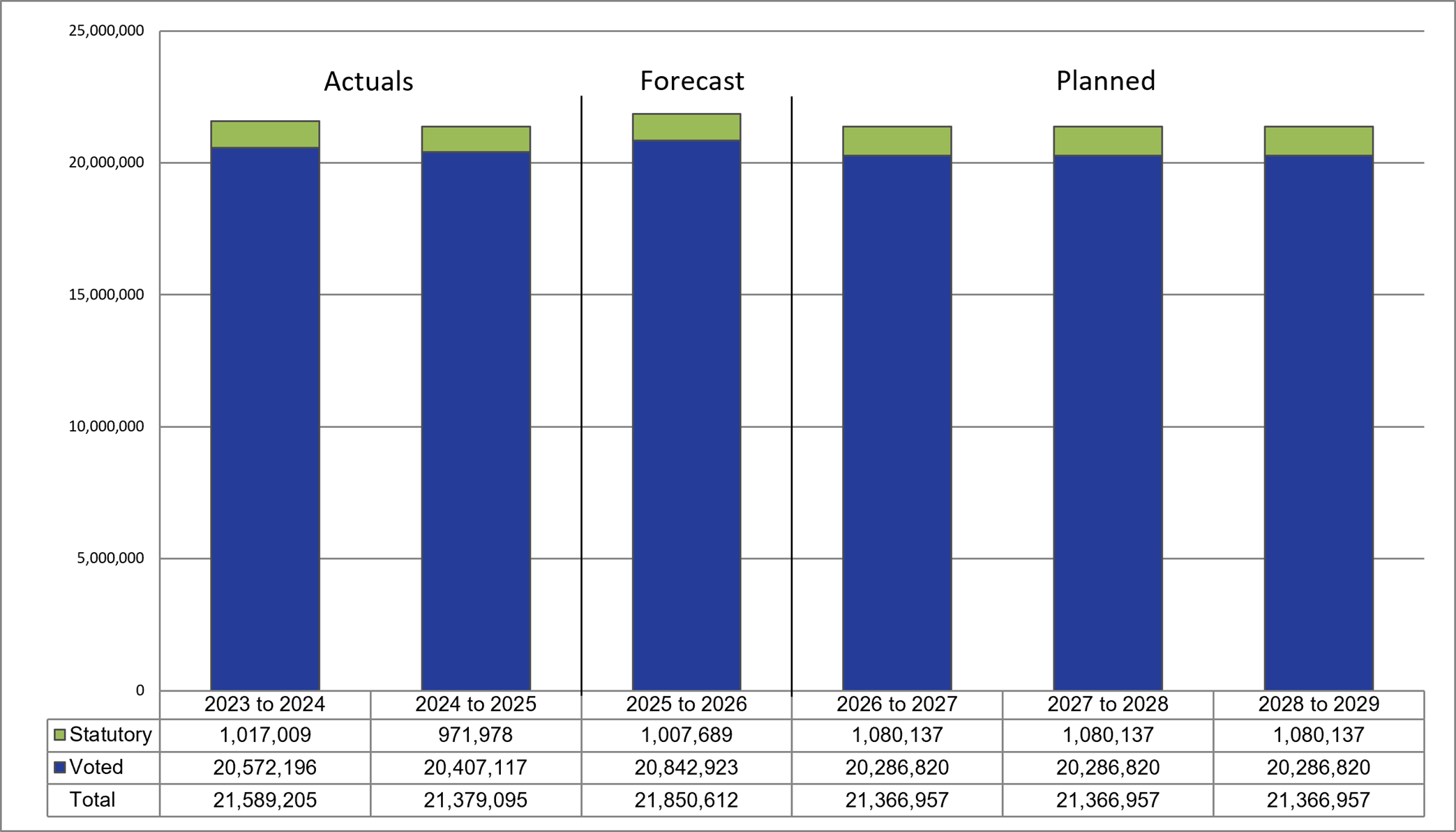
Statutory and voted funding
Table 10: Approved funding (statutory and voted) over a 6 year period (dollars)
Table 10 shows the approved statutory and voted funding of the organization for the period of 2023 to 2024 to 2028 to 2029.
| Fiscal year | Total | Voted | Statutory |
|---|---|---|---|
| 2023 to 2024 | 21,589,205 | 20,572,196 | 1,017,009 |
| 2024 to 2025 | 21,379,095 | 20,407,117 | 971,978 |
| 2025 to 2026 | 21,850,612 | 20,842,923 | 1,007,689 |
| 2026 to 2027 | 21,366,957 | 20,286,820 | 1,080,137 |
| 2027 to 2028 | 21,366,957 | 20,286,820 | 1,080,137 |
| 2028 to 2029 | 21,366,957 | 20,286,820 | 1,080,137 |
Analysis of statutory and voted funding over a 6-year period
Our funding has remained consistent for the past years following the successful ramp up of our operations.
For further information on Accessibility Standards Canada’s organization appropriations, consult the 2026 to 2027 Main Estimates.
Future-oriented condensed statement of operations
The future-oriented condensed statement of operations provides an overview of Accessibility Standards Canada’s operations for 2025 to 2026 to 2026 to 2027.
Table 11: Future-oriented condensed statement of operations for the year ended March 31, 2027 (dollars)
Table 11 summarizes the expenses and revenues which net to the cost of operations before government funding and transfers for 2025 to 2026 to 2026 to 2027. The forecast and planned amounts in this statement of operations were prepared on an accrual basis. The forecast and planned amounts presented in other sections of the Departmental Plan were prepared on an expenditure basis. Amounts may therefore differ.
| Financial information | 2025 to 2026 forecast results | 2026 to 2027 planned results | Difference (planned results minus forecasted) |
|---|---|---|---|
| Total expenses | 22,691,884 | 22,397,681 | (294,203) |
| Total revenues | 0 | 0 | 0 |
| Net cost of operations before government funding and transfers | 22,691,884 | 22,397,681 | (294,203) |
Analysis of forecasted and planned results
A more detailed Future-Oriented Statement of Operations and associated Notes for 2026 to 2027, including a reconciliation of the net cost of operations with the requested authorities, is available on Accessibility Standards Canada’s website.
Human resources
This section presents an overview of the organization’s actual and planned human resources from 2023 to 2024 to 2028 to 2029.
Table 12: Actual human resources for core responsibility and internal services
Table 12 shows a summary of human resources, in full-time equivalents, for Accessibility Standards Canada’s core responsibility and for its internal services for the previous 3 fiscal years. Human resources for the 2025 to 2026 fiscal year are forecasted based on year to date.
| Core responsibility and internal services | 2023 to 2024 actual full-time equivalents | 2024 to 2025 actual full-time equivalents | 2025 to 2026 forecasted full-time equivalents |
|---|---|---|---|
| Accessibility standards | 39 | 39 | 45 |
| Internal services | 24 | 23 | 18 |
| Total | 63 | 62 | 63 |
Analysis of human resources over the last 3 years
Our human resources have remained consistent for the past years following the successful ramp up of our operations.
Table 13: Human resources planning summary for core responsibility and internal services
Table 13 shows information on human resources, in full-time equivalents, of Accessibility Standards Canada’s core responsibility and for its internal services planned for the next 3 years.
| Core responsibility and internal services | 2026 to 2027 planned full-time equivalents | 2027 to 2028 planned full-time equivalents | 2028 to 2029 planned full-time equivalents |
|---|---|---|---|
| Accessibility standards | 45 | 45 | 45 |
| Internal services | 18 | 18 | 18 |
| Total | 63 | 63 | 63 |
Analysis of human resources for the next 3 years
Our human resources will remain consistent for the upcoming years following the successful ramp up of our operations.
Supplementary information tables
The following supplementary information tables are available on Accessibility Standards Canada’s website:
Information on Accessibility Standards Canada’s departmental sustainable development strategy can be found on Accessibility Standards Canada’s website.
Federal tax expenditures
Accessibility Standards Canada’s Departmental Plan does not include information on tax expenditures.
The tax system can be used to achieve public policy objectives through the application of special measures such as low tax rates, exemptions, deductions, deferrals and credits. The Department of Finance Canada publishes cost estimates and projections for these measures each year in the Report on Federal Tax Expenditures.
This report also provides detailed background information on tax expenditures, including descriptions, objectives, historical information and references to related federal spending programs as well as evaluations and GBA Plus of tax expenditures.
Corporate information
Organizational profile
The Honourable Patty Hajdu, Minister of Jobs and Families
Institutional head:
Mr. Dino Zuppa, Chief Executive Officer
Chairperson:
Mr. Paul Walsh, Chairperson of the Board of Directors
Ministerial portfolio:
Minister of Jobs and Families
Enabling instrument:
Year of incorporation/commencement:
2019
Organizational contact information
Accessibility Standards Canada
320 Saint-Joseph Boulevard, Suite 246
Gatineau, QC J8Y 3Y8
1-833-854-7628
1-833-854-7628
Website:
Definitions
List of terms
appropriation (crédit)
Any authority of Parliament to pay money out of the Consolidated Revenue Fund.
budgetary expenditures (dépenses budgétaires)
Operating and capital expenditures; transfer payments to other levels of government, departments or individuals; and payments to Crown corporations.
core responsibility (responsabilité essentielle)
An enduring function or role performed by a department. The intentions of the department with respect to a core responsibility are reflected in one or more related departmental results that the department seeks to contribute to or influence.
Departmental Plan (plan ministériel)
A report on the plans and expected performance of an appropriated department over a 3-year period. Departmental Plans are usually tabled in Parliament each spring.
departmental result (résultat ministériel)
A consequence or outcome that a department seeks to achieve. A departmental result is often outside departments’ immediate control, but it should be influenced by program-level outcomes.
departmental result indicator (indicateur de résultat ministériel)
A quantitative measure of progress on a departmental result.
departmental results framework (cadre ministériel des résultats)
A framework that connects the department’s core responsibilities to its departmental results and departmental result indicators.
Departmental Results Report (rapport sur les résultats ministériels)
A report on a department’s actual accomplishments against the plans, priorities and expected results set out in the corresponding Departmental Plan.
full-time equivalent (équivalent temps plein)
A measure of the extent to which an employee represents a full person-year charge against a departmental budget. For a particular position, the full-time equivalent figure is the ratio of number of hours the person actually works divided by the standard number of hours set out in the person’s collective agreement.
gender-based analysis plus (GBA Plus) (analyse comparative entre les sexes plus [ACS Plus])
Is an analytical tool used to support the development of responsive and inclusive policies, programs, and other initiatives. GBA Plus is a process for understanding who is impacted by the issue or opportunity being addressed by the initiative; identifying how the initiative could be tailored to meet diverse needs of the people most impacted; and anticipating and mitigating any barriers to accessing or benefitting from the initiative. GBA Plus is an intersectional analysis that goes beyond biological (sex) and socio-cultural (gender) differences to consider other factors, such as age, disability, education, ethnicity, economic status, geography (including rurality), language, race, religion, and sexual orientation.
Using GBA Plus involves taking a gender- and diversity-sensitive approach to our work. Considering all intersecting identity factors as part of GBA Plus, not only sex and gender, is a Government of Canada commitment.
government priorities (priorités gouvernementales)
For the purpose of the 2026 to 2027 Departmental Plan, government priorities are the high-level themes outlining the government’s agenda in the 2025 Speech from the Throne .
horizontal initiative (initiative horizontale)
An initiative where 2 or more federal departments are given funding to pursue a shared outcome, often linked to a government priority.
Indigenous business (entreprise autochtones)
Requirements for verifying Indigenous businesses for the purposes of the departmental result report are available through the Indigenous Services Canada Mandatory minimum 5% Indigenous procurement target website.
non‑budgetary expenditures (dépenses non budgétaires)
Non-budgetary authorities that comprise assets and liabilities transactions for loans, investments and advances, or specified purpose accounts, that have been established under specific statutes or under non-statutory authorities in the Estimates and elsewhere. Non-budgetary transactions are those expenditures and receipts related to the government’s financial claims on, and obligations to, outside parties. These consist of transactions in loans, investments and advances; in cash and accounts receivable; in public money received or collected for specified purposes; and in all other assets and liabilities. Other assets and liabilities, not specifically defined in G to P authority codes are to be recorded to an R authority code, which is the residual authority code for all other assets and liabilities.
performance (rendement)
What a department did with its resources to achieve its results, how well those results compare to what the department intended to achieve, and how well lessons learned have been identified.
performance indicator (indicateur de rendement)
A qualitative or quantitative means of measuring an output or outcome, with the intention of gauging the performance of a department, program, policy or initiative respecting expected results.
plan (plan)
The articulation of strategic choices, which provides information on how a department intends to achieve its priorities and associated results. Generally, a plan will explain the logic behind the strategies chosen and tend to focus on actions that lead to the expected result.
planned spending (dépenses prévues)
For Departmental Plans and Departmental Results Reports, planned spending refers to those amounts presented in Main Estimates.
A department is expected to be aware of the authorities that it has sought and received. The determination of planned spending is a departmental responsibility, and departments must be able to defend the expenditure and accrual numbers presented in their Departmental Plans and Departmental Results Reports.program (programme)
Individual or groups of services, activities or combinations thereof that are managed together within the department and focus on a specific set of outputs, outcomes or service levels.
program inventory (répertoire des programmes)
Identifies all the department’s programs and describes how resources are organized to contribute to the department’s core responsibilities and results.
result (résultat)
A consequence attributed, in part, to a department, policy, program or initiative. Results are not within the control of a single department, policy, program or initiative; instead they are within the area of the department’s influence.
statutory expenditures (dépenses législatives)
Expenditures that Parliament has approved through legislation other than appropriation acts. The legislation sets out the purpose of the expenditures and the terms and conditions under which they may be made.
target (cible)
A measurable performance or success level that a department, program or initiative plans to achieve within a specified time period. Targets can be either quantitative or qualitative.
voted expenditures (dépenses votées)
Expenditures that Parliament approves annually through an appropriation act. The vote wording becomes the governing conditions under which these expenditures may be made.