
Departmental Results Report 2025 to 2026
Copyright information
© His Majesty the King in Right of Canada, as represented by the Honourable Patty Hajdu, Minister of Jobs and Families, 2026
Catalogue number: AS1-3E-PDF
International Standard Serial Number (ISSN): 2563–5794
Aussi disponible en français sous le titre : Rapport sur les résultats ministériels 2025 à 2026
Note: Accessibility Standards Canada used its generative AI tool (Microsoft Copilot and EVA Chat) to support the development of content in this report. A human has reviewed and validated all AI-generated content.
At a glance
This Departmental Results Report details Accessibility Standards Canada’s actual accomplishments against the plans, priorities and expected results outlined in its 2025 to 2026 Departmental Plan.
These results align with the priorities outlined in the May 21, 2025, mandate letter from the Prime Minister, as well as with Accessibility Standards Canada’s vision, mission, raison d’être and operating context.
Key priorities
Accessibility Standards Canada identified the following key priorities for 2025 to 2026:
- Develop standards in the 7 priority areas of the Accessible Canada Act, including:
- publishing 2 standards
- publicly reviewing 3 standards
- launching 1 new standard
- establishing 1 new technical committee
- continuing to support technical committees as they advanced 13 standards at different stages of development
- jointly developing 1 standard with another standards development organization
- Increase collaborative opportunities, including expanding and strengthening partnerships with diverse disability organizations at the:
- local level
- national level
- international level
- Continue engagement with provincial and territorial governments.
- Strengthen engagement with federally regulated entities, industry and other interested parties. This is to encourage organizations to get involved in the development and use of standards and technical guides.
- Facilitate public access to information through the Centre of Expertise, including:
- standards in development and published standards
- research funded through the Grants and Contributions program
- technical guides that provide guidance and best practices
- Continue to ensure timely and consistent communications with the public through:
- our website
- social media
- news releases
- the distribution of our quarterly newsletters to interested parties
- Enhance communications by increasing visibility and promoting the organization’s participation at public events and activities. This includes reviewing the website’s information architecture to improve web presence and accessibility and ensuring that users’ needs are met.
Highlights
- Total actual spending (including internal services): $21,310,500
- Total full-time equivalent staff (including internal services): 61
For detailed information on Accessibility Standards Canada’s total spending and human resources, read the Spending and human resources section of this report.
Summary of results
The following provides a summary of the results the organization achieved in 2025 to 2026 under its “core responsibility” (its main area of activity).
Core responsibility: Accessibility Standards
Actual spending: $15,560,221
Actual human resources: 44
High-Level Summary: Accessibility Standards—Results achieved during 2025 to 2026
In the 2025 to 2026 fiscal year, we advanced our mandate by:
- Publishing new accessibility standards.
- Supporting research to inform future standards.
- Expanding access to information through our Centre of Expertise and enhancing:
- communications
- outreach
- digital services.
We engaged people living in Canada through public reviews, outreach activities, and events. We also strengthened partnerships with communities, governments, and international organizations.
Result 1: Research informs the next generation of standards.
We supported research that helps shape the future of accessibility standards in Canada through our funding program, Advancing Accessibility Standards Research. We did the following activities:
- Maintained strong relationships with funding recipients through regular virtual contact. This included monitoring project progress and deliverables in lieu of site visits.
- Launched a new call for funding for research projects starting in 2026 to 2027.
- Continued using a two-step application process to reduce administrative burden and improve accessibility for applicants.
- Reviewed final reports from projects completed between April 2021 and March 2025.
- Shared information on funded research projects through the new Funded research project database, (Centre of Expertise). This database includes updates on completed research. It also includes a tool to highlight new content and a tool to request completed research reports.
- Implemented the recommendations from our first program evaluation to support the continuous improvement of the funding program.
This work helps ensure that accessibility standards are informed by evidence and supported by diverse research projects.
Result 2: Accessibility Standards are in place to address barriers in priority areas as defined in section 5 of the Accessible Canada Act.
We continued to make progress in developing accessibility standards that help identify, remove, and prevent barriers. These standards support a more accessible Canada and are part of our long-term plan. We:
- published 4 standards
- published 4 technical guides
- held public reviews for 3 draft standards
- initiated recruitment for 2 new technical committees
- began development of 25 new standards
- continued to develop 10 other standards already in progress
- continued to collaborate with the International Code Council and CSA Group on jointly developing accessibility standards
- advanced other priority areas and deferred products as required based on competing priorities
These efforts demonstrate our commitment to developing inclusive, evidence-based standards. They reflect the lived experiences of people with disabilities and equity-deserving groups. People with disabilities play a leading role in our work and help shape our standards. Their contributions support a more accessible and inclusive Canada.
Our organization also advances accessibility through regulatory and non-regulatory approaches. These approaches help translate accessibility standards into practical tools that support organizations in identifying, removing and preventing barriers.
Result 3: Stakeholders are engaged in the delivery of our mandate.
We strengthened partnerships and expanded our reach to promote accessibility standards and support a more inclusive Canada. We conducted the following activities:
- Increased our interested parties’ database and newsletter subscriber list.
- Shared best practices in accessible workplace design through tours of our accessible office for partners and interested parties.
- Engaged directly with partners and interested parties, including diverse disability communities, nationally and internationally. This was to share information and promote the use of our standards and technical guides.
- Presented and participated in 19 national and international conferences and events to:
- gather insights
- foster collaboration
- increase awareness of accessibility
- Met regularly with federal partners. We also continued collaboration with provincial and territorial governments. This was to support coordinated implementation of accessibility initiatives.
- Expanded engagement with Indigenous communities, including Indigenous disability organizations and territorial governments.
These efforts strengthened relationships with partners and increased awareness of our standards and technical guides. They also supported a more inclusive and collaborative approach to standards development.
Result 4: Best practices on accessibility standards are publicized.
We improved how organizations and the public access information about accessibility. We achieved the following results:
- Achieved record levels of public engagement, with website traffic increasing by 78% and LinkedIn followers growing by 53%.
- Improved access to accessibility information through:
- the launch of new public databases
- a new secure online portal
- enhanced public review tools
- a new priority area webpage
- Increased public participation in standards development through new digital engagement tools and targeted public review campaigns.
- Published and promoted accessibility standards and technical guides in priority accessibility areas.
- Strengthened our position as a national and international leader on accessibility and expanded the reach of accessibility resources through:
- strategic communications partnerships
- accessible communications products
- Made more research reports available on demand in the new Funded research project database and added tools to highlight new content.
- Added new online guidance for recipients of the Grants and Contributions funding program to:
- improve accessibility
- clarify program requirements
- make it easier for funding recipients to complete deliverables
These actions strengthened our visibility and leadership in accessibility across Canada and internationally. They help make accessibility information more open, inclusive, and easy to use for everyone.
For more information on Accessibility Standards Canada’s activities related to Core responsibility: Accessibility Standards, read the “Results: What we achieved” section of this report.
From the Minister
When every person living in Canada has the fair chance to succeed, Canada is at its strongest. Accessibility Standards Canada continues to advance this important work, and its 2025 to 2026 Departmental Results Report highlights the progress made over the past year.
In a rapidly changing world, the organization must remain focused on what they can influence:
- building stronger communities
- a more resilient economy
- a more accessible Canada for everyone
Accessibility Standards Canada’s work supports key Government of Canada priorities. This includes accessible housing and inclusive workplaces to accessible digital services and the responsible development of emerging technologies such as artificial intelligence. By turning research and lived experience into practical tools and solutions, Accessibility Standards Canada helps organizations build accessibility into the forefront of what they do, and how they do it. This is how equal opportunity becomes a reality through everyday action.
This work also reinforces Canada’s leadership on accessibility around the world. Accessibility Standards Canada’s published standards contribute to 14 of the 17 United Nations Sustainable Development Goals. They also align with 25 of the 26 substantive Articles of the United Nations Convention on the Rights of Persons with Disabilities. These contributions reflect Canada’s commitment to advancing inclusion, protecting the rights of people with disabilities, and helping build a more accessible and equitable world for everyone.
Building a barrier-free Canada requires an all-hands-on deck approach. Governments, industry, researchers, community organizations and people with disabilities all play an essential role. I thank everyone whose expertise, lived experience and dedication continue to drive this important work forward.
Behind every barrier we remove is someone who gets to participate fully at work, in their community, and in everyday life. When everyone has an equal opportunity to succeed, Canada is stronger.

From the Chairperson
The greatest contribution a Board can make is to help an organization focus on where it can have the greatest impact. It is in that spirit that I am pleased to present the Accessibility Standards Canada Departmental Results Report for 2025 to 2026. This report highlights another year of meaningful progress toward our shared vision of a barrier-free Canada by 2040.
This was an important year for our Board of Directors. While continuing to provide strategic oversight of the organization, we also took time to reflect on how the Board can have the greatest long-term impact. Through a comprehensive strategic planning process, we supported Accessibility Standards Canada’s success by:
- clarifying our priorities
- refining our approach to governance
- reaffirming the unique contribution the Board plays
That work reinforced an important principle: the Board creates the greatest value by looking beyond day-to-day operations to help position the organization for the future. We challenge ourselves to anticipate emerging issues and bring diverse perspectives to the table. We also help ensure Accessibility Standards Canada remains responsive to the changing needs of the Canadian population.
People with disabilities continue to be at the centre of everything we do. Guided by the principle of “Nothing Without Us”, we are committed to ensuring that lived experience informs the Board’s decisions and the organization’s strategic direction. Together with the diverse expertise of our Directors, this helps ensure our work remains:
- relevant
- inclusive
- grounded in real life needs
Over the past year, we have also strengthened the Board’s role as a bridge between Accessibility Standards Canada and the broader accessibility community. By listening, learning and building relationships with partners across sectors and jurisdictions, we:
- help identify new opportunities
- encourage meaningful engagement
- support the adoption of accessibility standards and best practices beyond our organization
This perspective enriches both our governance and our contribution to a barrier-free Canada. It reflects the Board’s commitment to extending the influence of Accessibility Standards Canada’s work and positioning the organization as a national leader in accessibility.
As accessibility continues to evolve, so too is our leadership. The Board remains focused on:
- providing thoughtful stewardship
- fostering sound governance
- helping ensure Accessibility Standards Canada continues to focus its efforts where they can have the greatest impact
I extend my sincere thanks to my fellow Board members for their commitment and leadership, to our Chief Executive Officer and employees for their dedication. My appreciation also goes to the many others who contribute to our mission, including technical committee members, partners and persons with disabilities. Their experience and expertise continue to guide our work.
Together, we are helping ensure Accessibility Standards Canada remains a trusted leader in advancing accessibility today and shaping lasting change for generations to come.

From the Chief Executive Officer
This year showed what is possible when lived experience, expertise and collaboration come together to advance accessibility across Canada. Throughout 2025 to 2026, Accessibility Standards Canada continued to turn research and best practices into practical solutions that help organizations identify, remove and prevent barriers.
We strengthened Canada’s accessibility foundation by publishing new standards and technical guides while advancing future standards across several priority areas. Our work on accessible-ready housing, inclusive employment, and accessible and equitable artificial intelligence addressed important challenges facing the Canadian population. However, these challenges gave us opportunities to advance accessibility. The resources resulting from our work are more than publications. They are practical tools that organizations can use to improve accessibility in workplaces, services, housing, technologies and public spaces.
Strong standards are grounded in evidence. Through our Advancing Accessibility Standards Research program, we supported research that helps ensure future standards reflect:
- emerging issues
- innovative practices
- the lived experiences of persons with disabilities
This growing body of evidence keeps our work grounded, relevant and responsive to people’s changing needs.
Our greatest achievements this year were made possible through collaboration. No organization can advance accessibility alone. Governments, industry, researchers, communities and persons with disabilities help identify barriers and develop solutions that benefit everyone.
Every partnership, public review and conversation make our standards stronger and more impactful.
We improved digital services, launched new public engagement tools and expanded online resources through our Centre of Expertise. We also achieved record public engagement across our digital platforms. These improvements make it easier for people and organizations working to remove barriers to share, understand and apply accessibility knowledge.
People with disabilities lead our work and their lived experience shapes every stage of our standard development process. Their leadership helps ensure our work responds to real-world needs and that we develop solutions that reflect those needs.
Although we’re a micro-organization, our impact continues to grow. Every standard, technical guide, research project and partnership helps organizations consider accessibility from the start and make it part of everyday decisions. Accessibility benefits everyone, and we all have a role in advancing it.
I would like to thank our Board of Directors for their strategic guidance and our employees for their professionalism and commitment. I also thank our technical committee members for sharing their expertise, and our many partners and collaborators for their contributions to accessibility across Canada.
As we look ahead, we will continue to develop practical, evidence-based solutions. These solutions will help organizations integrate accessibility into the design of products, services and environments, as well as in the delivery of services. Accessibility isn’t a destination. It’s an ongoing commitment to doing better. Together, we’re helping shape a Canada where accessibility is built in, inclusion is intentional, and everyone can participate, contribute and thrive.

Results: What we achieved
Core responsibility and internal services
Core responsibility: Accessibility Standards
In this section
Description
Accessibility standards:
- develops and revises accessibility standards by establishing technical committees and providing research and support to them
- promotes, supports, and conducts research to inform the development of standards
- shares information with organizations and the public about standards
- provides products and services about standards
- provides best practices used to identify, remove, and prevent accessibility barriers
Technical committees reflect diversity and are made up of:
- people with disabilities
- Indigenous people
- representatives from industries that would have to follow standards if they were made into regulations
- other experts
Quality of life impacts
Accessibility Standards Canada’s core responsibility is to develop accessibility standards. This work contributes to various domains and indicators listed in the Quality of Life Framework for Canada.
Our mandate focuses on people with disabilities. All of our standards contribute to justice and human rights for people with disabilities. This is because our standards aim to ensure that people with disabilities are treated equally, fairly and with dignity. They also aim to ensure that people living with disabilities have equal access to all goods and services.
Our standards contribute to many areas of the framework:
- 2 indicators in the prosperity domain:
- employment
- financial well-being
- 4 indicators in the health domain:
- physical activity
- self-rated mental health
- functional health status
- health-adjusted life expectancy
- 5 indicators in the society domain:
- accessible environments
- participation in cultural or religious practices, recreation, or sport
- sense of belonging to the local community
- sense of meaning and purpose
- satisfaction with time use
- 4 indicators in the environment domain:
- satisfaction with the local environment
- walkable communities
- access to public transit
- natural disasters and emergencies
- 3 indicators in the good governance domain:
- discrimination and unfair treatment
- life satisfaction for people with disabilities sense of meaning and purpose
Progress on results
This section details the organization’s performance against its targets for each departmental result under our core responsibility: Accessibility Standards.
Table 1 shows the target, the date to achieve the target and the actual result for each indicator under “Research informs the next generation of standards” in the last 3 fiscal years.
| Departmental results indicators | Target | Date to achieve target | Actual results |
|---|---|---|---|
Indicator 1: Percentage of completed research project reports used by technical committees to inform new standards or revise existing ones. | 75% annually | March 31, 2026 | 2023 to 2024: Not applicable, new performance indicator. 2024 to 2025: Not applicable, new performance indicator. 2025 to 2026: 100% |
Table 2 shows the target, the date to achieve the target and the actual result for each indicator under “Accessibility Standards are in place to address barriers in priority areas as defined in section 5 of the Accessible Canada Act” in the last 3 fiscal years.
| Departmental results indicators | Target | Date to achieve target | Actual results |
|---|---|---|---|
Indicator 2: Number of standards developed or revised in priority areas. | 2 standards every 2 years | March 31, 2026 | 2023 to 2024: 0 2024 to 2025: 3 2025 to 2026: 8 |
Table 3 shows the target, the date to achieve the target and the actual result for each indicator under “Stakeholders are engaged in the delivery of our mandate” in the last 3 fiscal years.
| Departmental results indicators | Target | Date to achieve target | Actual results |
|---|---|---|---|
Indicator 3: Number of activities organized to engage stakeholders. | 5 activities annually | March 31, 2026 | 2023 to 2024: 16 2024 to 2025: 8 2025 to 2026: 11 |
Table 4 shows the target, the date to achieve the target and the actual result for each indicator under “Best practices on accessibility standards are publicized” in the last 3 fiscal years.
| Departmental results indicators | Target | Date to achieve target | Actual results |
|---|---|---|---|
Indicator 4: Number of reports, publications and best practices on accessibility standards made publicly available. | 7 reports and/or publications annually | March 31, 2026 | 2023 to 2024: Not applicable, new performance indicator. 2024 to 2025: Not applicable, new performance indicator. 2025 to 2026: 19 |
The Results section of the Infographic for Accessibility Standards Canada on GC Infobase provides additional information on results and performance related to its program inventory.
Details on results
The following section describes the results for Accessibility Standards in 2025 to 2026 compared with the planned results set out in Accessibility Standards Canada’s Departmental Plan for the year.
Result 1: Research informs the next generation of standards.
Results achieved
Supporting research is a key part of our mandate. Through our Grants and Contributions program, Advancing Accessibility Standards Research, we fund diverse research projects. These projects aim to inform the development of next-generation accessibility standards in federal areas of responsibility. This research helps inform our standards. It can also encourage other organizations to adopt the standards we develop.
In the 2025 to 2026 fiscal year, we did the following activities:
- Maintained and strengthened relationships with funding recipients through regular virtual contact. This included continuing to monitor the progress of funded projects in lieu of site visits.
- Launched another call for funding. This call was for projects starting in the 2026 to 2027 fiscal year. We selected projects that best met the program’s:
- purpose
- objectives
- assessment criteria
Continued our 2-step process for our call for funding. In the first step, we invited organizations from across Canada to submit an Expression of Interest (EOI), meaning:
- a short description of their project
- how their project meets the program’s objectives
- the total funding required for their project
We assessed each submission and identified the projects that best met the program’s purpose and objectives. In step 2, we only invited those selected to submit a full application package for funding. This included submitting:
- a detailed proposal
- a detailed budget
- supporting documentation
This approach reduces the administrative burden on applicants. It also made applying for research funding more efficient and accessible.
We received an exceptionally high number of quality EOIs. As a result, we signed funding agreements with the successful applicants in step two. We invited some applicants to submit a detailed proposal under step 2 for consideration for funding in 2027 to 2028. This approach helps ensure we can fund relevant projects in future years.
- Reviewed the research reports for projects completed between April 2021 and March 2025.
- Shared information on funded research projects through the new Funded research project database, (Centre of Expertise). This includes updates on completed research projects, the ability to request completed research reports and a tool to highlight new content.
- Implemented the recommendations from our first program evaluation. This ensures we continue to provide quality program delivery for our recipients, as well as continue to collect meaningful data to report to all people living in Canada.
Result 2: Accessibility Standards are in place to address barriers in priority areas as defined in section 5 of the Accessible Canada Act.
Results achieved
A key part of our mandate is to create accessibility standards. We also revise current ones. The Board of Directors determines the priority areas for standards, based on input from:
- our staff
- interested parties
- the public
Standards describe how organizations can identify, remove, and prevent barriers to accessibility.
In the 2025 to 2026 fiscal year, we did the following:
- published 4 standards:
- published 4 technical guides:
- held public reviews for 3 draft standards:
- initiated recruitment for 2 new technical committees:
- began development of 25 new standards:
- Accessible Childcare Centres
- Accessible-Ready Small Homes
- Accessible-Ready Modular and Prefabricated Housing
- Accessible Communities
- Equitable Communication
- Accessible Justice: Federal Courts and Tribunals
- Accessible Justice: Legal Capacity
- Common approach to disability
- Authoring Tool Accessibility Guidelines (ATAG) 3.0
- Accessible and Equitable Generative and Physical Artificial Intelligence Systems
- Accessible Cybersecurity
- Accessible Travel Journey: Built Environment, Design and Construction for Transit Facilities
- Accessible Travel Journey: Built Environment, Use and Maintenance for Transit Facilities
- Accessible Travel Journey: Built Environment, Design and Construction for Airports
- Accessible Travel Journey: Built Environment, Use and Maintenance for Airports
- Accessible Travel Journey: Built Environment, Design and Construction for Subway Stations
- Accessible Travel Journey: Built Environment, Use and Maintenance for Subway Stations
- Accessible Travel Journey: Built Environment, Design and Construction for Bus Stations
- Accessible Travel Journey: Built Environment, Use and Maintenance for Bus Stations
- Accessible Travel Journey: Built Environment, Design and Construction for Passenger Rail Stations
- Accessible Travel Journey: Built Environment, Use and Maintenance for Passenger Rail Stations
- Accessible Travel Journey: Built Environment, Design and Construction for Ferry Ports
- Accessible Travel Journey: Built Environment, Use and Maintenance for Ferry Ports
- Accessible Travel Journey: Built Environment, Design and Construction for Cruise Ship Ports
- Accessible Travel Journey: Built Environment, Use and Maintenance for Cruise Ship Ports
- continued developing 10 other standards already in development from previous years in areas such as:
- built environment
- outdoor spaces
- accessible procurement
- continued to collaborate with the International Code Council and CSA Group on 3 jointly developed accessible standards:
We also advanced other priority areas and deferred products as required based on competing priorities. This includes the deferral of the Accessible Tourism standard and the establishment of the technical committee to develop the standard.
These efforts show our commitment to developing inclusive and evidence-based standards. Our work reflects the lived experiences of people with disabilities and equity-deserving groups.
Driving change through regulatory and non-regulatory approaches
Our organization advances accessibility through regulatory and non-regulatory approaches. We recommend standards to the Minister for consideration of adoption into regulations. We also promote their use through:
- federal policies
- directives
- strategies
- guidance
- procurement tools
- other implementation instruments
This approach is already influencing accessibility across the federal government. For example:
- Accessibility requirements for ICT products and services was incorporated by reference into the Accessible Canada Regulations. This was reflected in federal digital accessibility policies, guidance and procurement resources.
- Employment informed Employment and Social Development Canada’s Employment Strategy for Canadians with Disabilities and was recommended for broader use across the federal public service.
- Accessible-Ready Housing has been recommended to support future housing and building code initiatives, including the next edition of the National Building Code. It is also referenced in the Canada Mortgage and Housing Corporation’s Housing Design Catalogue.
- Accessible and Equitable Artificial Intelligence Systems has been recommended to support the Government of Canada’s evolving approach to AI. This includes federal AI policies, strategies and governance instruments. As one of the first standards of its kind in the world, it also contributes to international discussions on accessible and equitable AI.
- Plain Language is referenced in Treasury Board Secretariat’s Policy on Communications and Federal Identity and Directive on the Management of Communications and Federal Identity.
These approaches help translate accessibility standards into practical tools that support organizations in identifying, removing and preventing barriers.
At Accessibility Standards Canada, people with disabilities lead and are actively involved in our work. They also contribute to our organizational culture. Their input has a real impact on all people living in Canada. Together, we are building a more accessible and inclusive Canada.
Result 3: Stakeholders are engaged in the delivery of our mandate.
Results achieved
We strengthened partnerships and expanded our reach to promote accessibility standards and support a more inclusive Canada. We:
- Grew our partners and interested parties database and newsletter subscribers list. They increased by 446 individuals and organizations in quarter 3 and 363 in quarter 4 (when we started tracking this data).
- Shared best practices in accessible workplace design through tours of our accessible office for:
- government departments
- standards development organizations
- national and international partners and interested parties
This helped advance awareness and understanding of accessibility in the built environment.
- Contributed to conferences, events, panel discussions and committees across Canada to:
- gather partner insights
- foster collaboration
- increase awareness of our role in advancing accessibility
- Engaged directly with diverse disability communities and industry to deepen our understanding and promote the use of our standards and technical guides. This included:
- presenting at 15 national conferences and events
- meetings with 5 national and regional organizations
- Presented at 4 international conferences and events to advance global accessibility dialogue. We also initiated meetings with 15 international partners and interested parties to strengthen information sharing and collaboration.
- Met regularly with federal partners who have mandates under the Accessible Canada Act. This included regular meetings with the Key Federal Accessibility Partners to coordinate efforts and collaborate on implementing the Act. These meetings focused on standards and technical guides. The 5 partners were:
- the Chief Accessibility Officer (CAO)
- the Accessibility Commissioner (AC) at the Canadian Human Rights Commission (CHRC)
- the Chairperson/CEO at the Canadian Transportation Agency (CTA)
- the Chairperson/CEO and staff at the Canadian Radio-television and Telecommunications Commission (CRTC)
- the Director General at the Accessible Canada Directorate for Employment and Social Development Canada (ESDC)
- Met with 13 additional federal partners to provide recommendations on the use of our standards, technical guides and existing requirements.
- Continued collaboration with provincial and territorial governments.
- Held 7 multilateral technical briefing sessions with provinces and territories.
- Expanded engagement with Indigenous communities, including Indigenous disability organizations and territorial governments.
These efforts ensure our standard development process is inclusive, collaborative, and reflective of the diverse voices working to build a Canada without barriers.
Although our organization did not convene an Annual Public Meeting as originally planned, we remained committed to transparency and public engagement throughout the year. We shared information about our work and provided meaningful opportunities for partners and interested parties to participate in standard development activities.
Result 4: Best practices on accessibility standards are publicized.
Results achieved
We continued to implement a dynamic and strategic roll-out plan to promote our work. We focused on visibility and engagement, and improving how users discover, access and participate in our work. We:
- Demonstrated growing demand for our accessibility publications and resources by achieving record levels of public awareness and engagement with:
- standard
- technical guide
- research.
Our website traffic increased by 78% compared to the previous year. More than 199,000 users visited our website. Our LinkedIn followers also grew by 53% to more than 10,400.
- Improved access to accessibility information significantly through:
- the launch of two new public databases;
- a new online secure portal
- enhanced public review tools
- a new priority area webpage that centralizes:
- standards
- technical guides
- research resources
- Increased public participation in standards development through new digital engagement tools and targeted public review campaigns. More than 350 users created portal accounts and submitted over 700 comments during the first public review using the new platform. This exceeds average participation levels.
- Supported the publication and promotion of major accessibility standards and technical guides successfully, including resources related to:
- plain language
- artificial intelligence systems
- accessible-ready housing
- procurement
- accessible service delivery
- childcare centres
This helped organizations access free of charge practical tools to advance accessibility.
- Adopted a more audience-centred approach to external communications by applying:
- plain language
- inclusive language best practices
- the use of data-informed storytelling techniques
Content featuring practical accessibility examples, real-life situations and timely themes tied to recognized national and international accessibility awareness campaigns generated record engagement. It also strengthened our position as a trusted source of accessibility information and expertise.
- Strengthened accessibility and inclusion by providing information in accessible formats, including:
- plain and inclusive language
- American Sign Language (ASL)
- Langue des signes québécoise (LSQ)
This helped a broader range of audiences access and understand accessibility resources.
- Strengthened our position as a national and international leader on accessibility through strategic communications partnerships and coordination with other organizations. Joint initiatives, targeted communications and collaborative campaigns helped extend the reach of accessibility standards and best practices to new audiences across Canada and internationally. These efforts include:
- leading over 25 coordinated communications, social media and advertising campaigns
- publishing 28 newsletters to partners and interested parties
- collaborating with media partners, other levels of governments and disability organizations
- Shared information on funded research projects through the new Funded research project database, (Centre of Expertise). This includes updates on completed research, the ability to request completed research reports, and a tool to highlight new content.
- Added new online guidance for recipients of the Grants and Contributions funding program. This guidance improves accessibility, clarifies program requirements and makes it easier for funding recipients to complete their deliverables.
Key risks
Accessibility Standards Canada has made great progress in building a strong and inclusive foundation for its work. However, there are still some unique challenges that may require mitigation. The main risks we identified are outlined below alongside strategies to manage them effectively.
Stakeholder engagement duplication leading to consultation fatigue.
We took steps to mitigate this risk. We led a consultation for our 2026 to 2028 Accessibility Plan that targeted people who already interact with us. This included:
- employees
- Board members
- technical committee members
- grants and contributions recipients
A member of our Board of Directors also led three public review sessions with interested parties through an existing forum: the Canadian Accessibility Network—Policy Community of Practice.
We met regularly with our partners that have mandates under the Accessible Canada Act to coordinate outreach activities. This included collaborating on joint presentations and meetings to find efficiencies.
Failure to provide accessible services, products, and information to the public.
To mitigate this risk, we continued to prioritize accessibility in:
- the design and delivery of our services
- products
- communications
We applied accessibility requirements and best practices to:
- public-facing information
- publications
- digital content
- engagement activities
We sought and implemented feedback from people with disabilities and other partners and interested parties to identify and address potential barriers. We also provided employees with tools, guidance, and training to support the delivery of accessible products and services.
Resources required to achieve results
Table 5 provides a summary of the planned and actual spending and full-time equivalents required to achieve results.
| Resource | Planned | Actual |
|---|---|---|
Spending | $15,881,429 | $15,560,221 |
Full-time equivalents | 45 | 44 |
The Finances section of the Infographic for Accessibility Standards Canada on GC Infobase page and the People section of the Infographic for Accessibility Standards Canada on GC Infobase page provide complete financial and human resources information related to its program inventory.
Related government priorities
This section highlights government priorities that are being addressed through our core responsibility.
Gender-based Analysis Plus (GBA Plus)
Accessibility Standards Canada remains committed to applying a GBA Plus and intersectional approach across its programs, policies and activities. We recognize that people with disabilities have diverse experiences and identities. To reflect this, our organization promotes diversity and awareness of intersectionality among its leadership, technical committees and staff. The objective of reflecting the needs and experiences of the broad diversity of people living with disabilities guides the work of the Board of Directors and technical committees.
This approach is embedded within our core responsibility. In standards development, technical committees are intentionally designed to include people with disabilities and representatives from equity-deserving groups. This ensures that lived experiences and diverse perspectives inform the development of accessibility standards. The majority of members of the Board of Directors are people with disabilities. Over 50% of technical committee members identify as people with disabilities and over 80% identify as belonging to at least one equity-deserving group. These groups include:
- women
- visible minorities
- Indigenous peoples
- members of 2SLGBTQI+ community
This representation helps ensure that standards reflect the diverse realities and needs of all people living in Canada.
Our Grants and Contributions program continues to require recipients to consider intersectionality in the design and delivery of their research projects and to involve people with disabilities throughout their work. 60% of people involved in research projects identify as people with disabilities and over 80% identify as part of an equity-deserving group. This supports the creation of evidence that reflects the experiences of diverse populations and helps inform future accessibility standards.
In the 2025 to 2026 fiscal year, we also strengthened the integration of GBA Plus within the Outreach and Knowledge Application program. This consisted of finalizing a GBA Plus Strategy and developing an operational framework to support future measurement and reporting. Communications and outreach activities incorporated:
- inclusive language
- plain language principles
- diverse visual representations
- an intersectional lens
This was integrated across:
- communications and social media campaigns
- messaging
- newsletters
- consultations
- engagement activities with partners and interested parties
Our organization expanded access to information through:
- new accessible digital tools
- a new public review feedback form
- targeted communications products
We gathered diverse perspectives on accessibility barriers and solutions by engaging:
- disability organizations
- accessibility advisory bodies
- employers
- researchers
- governments
- international partners
To strengthen future analysis and reporting, our organization began collecting voluntary demographic information through consultations related to our 2026 to 2028 Accessibility Plan. This work will help establish baseline information and support the continued integration of GBA Plus considerations into:
- organizational decision-making
- outreach activities
- accessibility initiatives
Artificial intelligence
In the 2025 to 2026 fiscal year, Accessibility Standards Canada advanced organizational readiness for the responsible adoption of AI. We:
- Rolled out Microsoft Copilot to employees. This provided access to an approved AI tool to support productivity and efficiency.
- Developed and delivered internal presentations and workshops on AI tools, Government of Canada guidance and best practices. These activities helped employees better understand artificial intelligence and use it safely and effectively.
- Raised awareness of governance, privacy, security and information management considerations related to AI adoption. This established a solid foundation for future AI-enabled initiatives in support of its mandate.
Program inventory
Our core responsibility, Accessibility Standards, is supported by the following programs:
Standards development
This program, which includes both standards development and research funding activities, supports the following activities:
- Developing standards through technical committees.
- Managing funding for research projects. These projects aim to identify and remove existing accessibility barriers and prevent new ones.
- Maintaining our accreditation as a standards development organization.
- Collaborating with provincial and territorial governments and supporting their participation.
Outreach and knowledge application
This program:
- Raises awareness of accessibility standards, research and accessibility-related resources among people living in Canada and interested parties.
- Engages with:
- people with disabilities
- organizations
- governments
- employers
- other partners
This facilitates the sharing of knowledge, technical guidance and best practices on accessibility barriers and solutions.
- Supports accessibility-related consultations and public reviews of draft standards which inform the development of accessibility standards.
- Promotes the application of:
- accessibility standards
- research findings
- best practices
This is achieved through outreach activities, conferences, events and partner engagements.
Additional information related to the program inventory for Accessibility Standards is available on the Results page on GC Infobase.
Internal services
In this section:
Description
Internal services are the activities and resources that support a department in meeting its corporate obligations and delivering its programs. The 10 categories of internal services are:
- acquisition management services
- communications services
- financial management services
- human resources management services
- information management services
- information technology services
- legal services
- materiel management services
- management and oversight services
- real property management services
Progress on results
This section presents details on how the organization performed to achieve results and meet targets for internal services.
Acquisitions
We continued to align procurement practices with Government of Canada policies, directives, and guidelines. We carried out procurement activities in a manner that supported sound stewardship, transparency, fairness, and value for money.
Communications
We strengthened organization-wide communications through strategic advice, planning support and product review. We helped teams develop and promote standards, technical guides, public reviews, funding opportunities and other key initiatives. We also reviewed communications products to keep them clear, consistent, accessible and aligned with our priorities. We supported internal communications by producing the Accessibility Monthly newsletter and maintaining accessible communications tools and templates. We also provided training and guidance on plain language, accessibility and emerging communications practices. This included plain language training for the Board of Directors and AI training for employees.
We strengthened communications governance, planning and performance measurements by improving reporting tools, evaluation processes, and analytics practices. We also developed a misinformation and disinformation strategy to prepare for emerging communications risks and support a coordinated response.
We supported digital transformation by developing new engagement and reporting tools. This includes a web-based public review dashboard, a user portal and a new public review feedback form. We updated web content and improved functions to improve access to standards, technical guides and other key resources. These changes support evidence-based decision-making, continuous improvement and more effective engagement with people living with disabilities.
Human resources
The organization has established itself as a benchmark for diversity, inclusion and accessibility throughout the 2025 to 2026 fiscal year. We integrated central agency priorities for equity, inclusion and accessibility into human resources programs and policies. In addition, the implementation of the digital passport on accessibility has helped reduce barriers. This promotes a more inclusive work environment for everyone. The creation of a new Equity, Diversity and Inclusion committee has signalled our continued commitment to promoting an inclusive and healthy workplace. This reinforces our leadership in these critical areas. Finally, the implementation of our employment standard within our organization has positioned us as a leader in accessibility within the federal public service.
We were committed to providing professional development opportunities to our staff members while recognizing their contributions. We also provided support for their mental health and engagement. The launch of a new recognition program, accompanied by an annual awards ceremony, highlighted the outstanding work of our teams. We launched an action plan on engagement and mental health. Many activities, such as Engagement and Mental Health Day, have fostered growth and a sense of belonging among all staff. These efforts demonstrate our leadership and commitment to wellness and valuing each member of our team.
Information technology and information management
We focused on making our digital tools more accessible and inclusive for all employees, especially those with disabilities. We did this by expanding access to accessible business tools. We also consulted employees to identify areas of improvement to assistive technologies. In addition, we reviewed our file-sharing practices to support better collaboration. This work laid the foundation for upgrades. These include the migration to SharePoint Online in the 2025 to 2026 fiscal year. We provided employees with increased access to AI programs. We also continued working on the government’s AI priorities. These efforts support our goal of creating a more inclusive and efficient digital workplace.
Real property
We maintained ongoing communication with our partners. We also gathered feedback from our employees to incorporate Universal Design Principles into our workspace. This ongoing collaboration improved the employee experience. It also reinforced our commitment to accessibility leadership while meeting federal government standards. We also advanced sustainability by installing automated fixtures that reduce water and energy consumption.
Resources required to achieve results
Table 6 provides a summary of the planned and actual spending and full-time equivalents required to achieve results.
| Resource | Planned | Actual |
|---|---|---|
Spending | $5,725,796 | $5,750,279 |
Full-time equivalents | 18 | 17 |
The Finances section of the Infographic for Accessibility Standards Canada on GC Infobase and the People section of the Infographic for Accessibility Standards Canada on GC Infobase provide complete financial and human resources information related to its program inventory.
Contracts awarded to Indigenous businesses
Government of Canada departments are required to award at least 5% of the total value of contracts to Indigenous businesses each year.
As shown in Table 7, Accessibility Standards Canada awarded 9.64% of the total value of all contracts to Indigenous businesses for the fiscal year.
| Contracting performance indicators | 2025 to 2026 results |
|---|---|
Total value of contracts awarded to Indigenous businesses (A) | $98,562 |
Total value of contracts awarded to Indigenous and non‑Indigenous businesses (B) | $4,210,699 |
Value of exceptions approved by deputy head (C) | $3,188,179 |
Proportion of contracts awarded to Indigenous businesses [A / (B−C) × 100] | 9.64% |
Notes
For the purposes of the minimum 5% target, Indigenous Services Canada defines “Indigenous businesses” as:
- businesses owned and operated by Elders, band and tribal councils
- businesses registered in the Government of Canada’s Indigenous Business Directory
- registered on a modern treaty beneficiary business list
A “contract” is a binding agreement for the procurement of a good, service or construction and does not include real property leases. It includes contract amendments and contracts entered into by means of acquisition cards of more than $10,000.
Due to the specific nature of Accessibility Standards Canada’s business, there is a small pool of vendors from which to choose for the bulk of the organization’s needs. The procurement team makes a concerted effort to identify indigenous vendors in all areas in order to meet the threshold.
- For the purposes of the minimum 5% target, the data in this table reflects how Indigenous Services Canada (ISC) defines “Indigenous business” as either:
- owned and operated by Elders, band and tribal councils
- registered in the Indigenous Business Directory
- registered on a modern treaty beneficiary business list
Accessibility Standards Canada exceeded its minimum target of 5% by achieving a result of 9.64%, nearly doubling the established target.
The Standards development process includes providing technical committees with the proper environmental scan and research to identify the barriers to accessibility for people living in Canada. Research contracts require specific criteria and expertise to be met in preparing this documentation. These include having an extensive background in the field being scanned and also having either lived experience or working with people with disabilities.
After many requests for proposals and other outreach measures, we received limited number of bids and none of them were from Indigenous businesses. This information led to the conclusion that the services are from a highly-specialized environment limited to few businesses across Canada. We will continue to provide the opportunities to all businesses to submit bids.
This exception is reviewed regularly and will change if market availability for these services increases.
On all other procurement, our organization continues to put an emphasis on collaborating with Indigenous businesses when available. This focus and planning are reflected in the 9.64% of total value of contracts being awarded to Indigenous businesses.
In its 2026 to 2027 Departmental Plan, the organisation planned to award at least 5% of the total value of its contracts to Indigenous businesses by the end of the 2025 to 2026 fiscal year.
Spending and human resources
In this section:
Spending
This section presents an overview of the organization’s actual and planned expenditures from 2023 to 2024 to 2028 to 2029.
Budgetary performance summary
Table 8 shows the money that Accessibility Standards Canada spent in each of the past 3 years on its core responsibility and on internal services.
| Core responsibility and internal services | 2025 to 2026 Main Estimates | 2025 to 2026 total authorities available for use | Actual spending over 3 years (authorities used) |
|---|---|---|---|
Accessibility Standards | 15,600,952 | 15,737,221 |
|
Internal services | 5,693,557 | 6,086,781 |
|
Total | 21,294,509 | 21,824,002 |
|
Analysis of the past 3 years of spending
Spending on the core responsibility for accessibility standards has reached a steady state. We observed no significant year-over-year variance in the past fiscal year. This reflects that the organization has completed the initial ramp-up phase and is now operating within a stable structure. We allocated our resources in a strategic and efficient manner to support the delivery of our mandate.
The Finances section of the Infographic for Accessibility Standards Canada on GC Infobase provides more financial information from previous years.
Planned spending for next 3 years
Table 9 shows Accessibility Standards Canada’s planned spending for each of the next 3 years on its core responsibility and on internal services.
| Core responsibility and internal services | 2026 to 2027 planned spending | 2027 to 2028 planned spending | 2028 to 2029 planned spending |
|---|---|---|---|
Accessibility Standards | 15,641,161 | 15,641,161 | 15,641,161 |
Internal services | 5,725,796 | 5,725,796 | 5,725,796 |
Total | 21,366,957 | 21,366,957 | 21,366,957 |
Analysis of the next 3 years of planned spending
Accessibility Standards Canada’s financial split reflects the distribution outlined in the Departmental Plan. With the organization now operating at a steady state, we will incorporate adjustments in future reporting to better align with operational requirements.
The Finances section of the Infographic for Accessibility Standards Canada on GC Infobase provides more detailed financial information related to future years.
Funding
This section provides an overview of the organization’s voted and statutory funding for its core responsibility and for internal services.
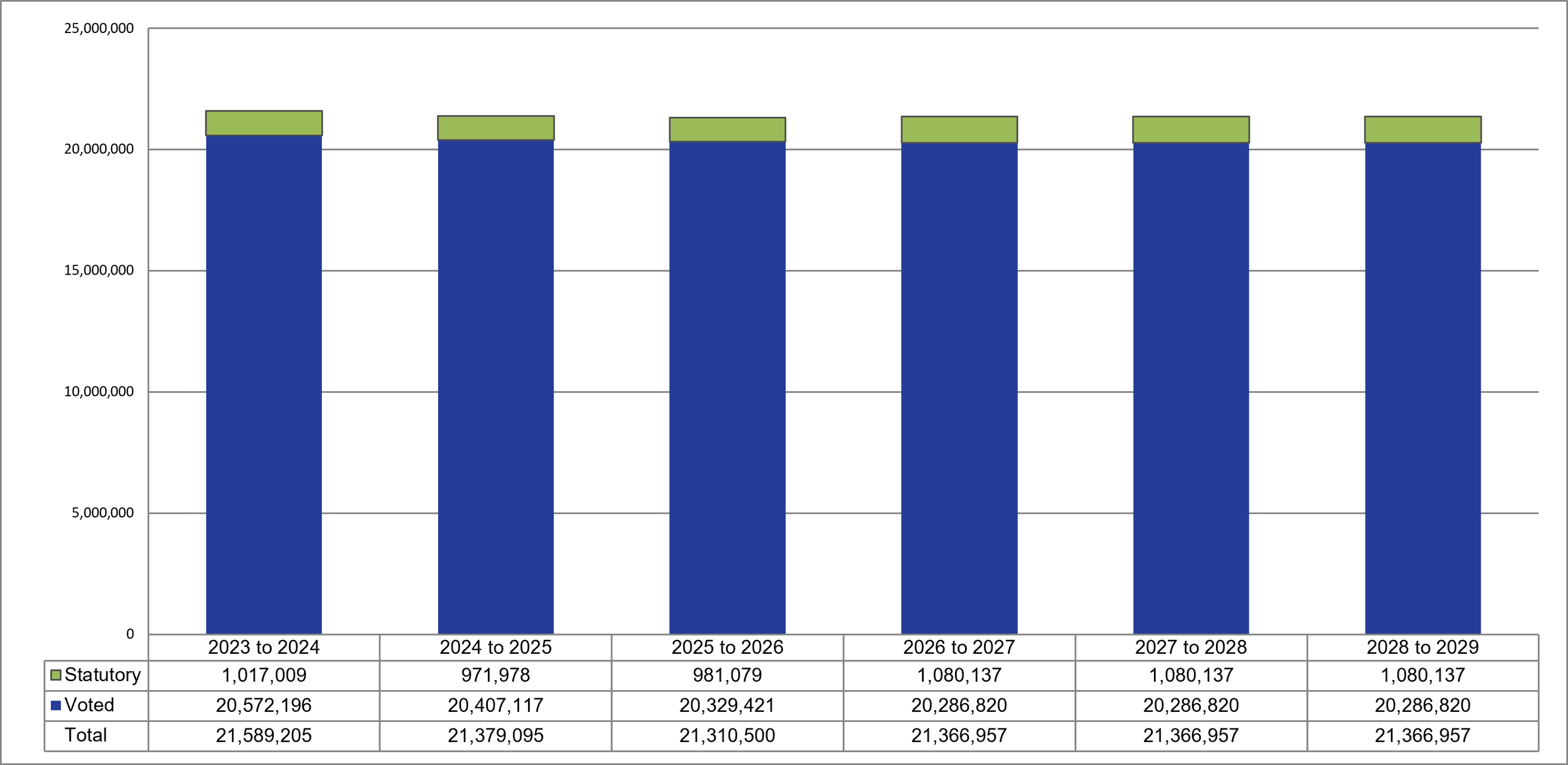
Graph 1 summarizes the organization’s approved voted and statutory funding from 2023 to 2024 to 2028 to 2029.
Graph 1: Approved funding (statutory and voted) over a 6-year period (dollars)
Graph 1 - description
Bar graph showing how much money was planned for each year from 2023 to 2024 to 2028 to 2029. Each bar has a blue part for voted funding and a small green part for statutory funding. The total budget starts at $21.589 million in 2023 to 2024, decreases slightly to $21.379 million in 2024 to 2025, decreases slightly again to $21.311 million in 2025 to 2026. The total budget then increases slightly to $21.367 million in 2026 to 2027, remaining stable at that level through 2028 to 2029. Voted funding represents the majority of funding each year, ranging from about $20.3 million to $20.6 million, while statutory funding remains relatively stable at approximately $1 million annually.
Table 10 shows the approved statutory and voted funding of the organization for the period of 2023 to 2024 to 2028 to 2029.
| Fiscal year | Statutory | Voted | Total |
|---|---|---|---|
2023 to 2024 | 1,017,009 | 20,572,196 | 21,589,205 |
2024 to 2025 | 971,978 | 20,407,117 | 21,379,095 |
2025 to 2026 | 981,079 | 20,329,421 | 21,310,500 |
2026 to 2027 | 1,080,137 | 20,286,820 | 21,366,957 |
2027 to 2028 | 1,080,137 | 20,286,820 | 21,366,957 |
2028 to 2029 | 1,080,137 | 20,286,820 | 21,366,957 |
Analysis of statutory and voted funding over a 6-year period
Over the past 3 years, Accessibility Standards Canada has expanded its organizational capacity. With staffing levels now stabilized, we continue to strengthen internal policies, procedures and service delivery. This includes bringing certain functions in-house. Our organization is now operating at a steady state and will continue to deliver our mandate through stable operations.
Consult the Public Accounts of Canada for further information on Accessibility Standards Canada’s departmental voted and statutory expenditures.
Financial statement highlights
This section presents Accessibility Standards Canada’s Financial statements (Unaudited) for the year ended March 31, 2026.
Table 11 summarizes the expenses and revenues for 2025 to 2026, which net to the cost of operations before government funding and transfers.
| Financial information | 2025 to 2026 actual results | 2025 to 2026 planned results | Difference (actual results minus planned) |
|---|---|---|---|
Total expenses | 22,213,209 | 22,691,884 | (478,675) |
Total revenues | 0 | 0 | 0 |
Net cost of operations before government funding and transfers | 22,213,209 | 22,691,884 | (478,675) |
Analysis of expenses and revenues for 2025 to 2026
Accessibility Standards Canada achieved results within 2% of the projections in its Future-Oriented Statement of Operations.
The 2025 to 2026 planned results information is provided in Accessibility Standards Canada’s Future-Oriented Statement of Operations and Notes 2025 to 2026.
Table 12 summarizes actual expenses and revenues and shows the net cost of operations before government funding and transfers.
| Financial information | 2025 to 2026 actual results | 2024 to 2025 actual results | Difference (2025 to 2026 minus 2024 to 2025) |
|---|---|---|---|
Total expenses | 22,213,209 | 22,118,917 | 94,292 |
Total revenues | 0 | 0 | 0 |
Net cost of operations before government funding and transfers | 22,213,209 | 22,118,917 | 94,292 |
Analysis of differences in expenses and revenues between 2024 to 2025 and 2025 to 2026
This slight increase in year over year expenditures is a reflection of improved internal procedures. This allowed for better budgetary planning, and, consequently, more efficient use of allotted funds.
Table 13 provides a brief snapshot of the amounts the organization owes or must spend (liabilities) and its available resources (assets), which helps to indicate its ability to carry out programs and services.
| Financial information | Actual fiscal year (2025 to 2026) | Previous fiscal year (2024 to 2025) | Difference (2025 to 2026 minus 2024 to 2025) |
|---|---|---|---|
Total net liabilities | 2,590,403 | 3,506,892 | (916,489) |
Total net financial assets | 2,246,085 | 3,023,133 | (777,048) |
Organization net debt | 344,318 | 483,759 | (139,441) |
Total non-financial assets | 1,444,968 | 1,860,120 | (415,152) |
Organization net financial position | 1,100,650 | 1,376,361 | (275,711) |
Analysis of organization’s liabilities and assets since last fiscal year
Total net liabilities decreased mainly because we recorded significant year-end invoices in the previous fiscal year. Total net financial assets also decreased due to a lower amount due from the Consolidated Revenue Fund at year-end. Total non-financial assets decreased as we continued to amortize our tangible capital assets.
Human resources
This section presents an overview of the organization’s actual and planned human resources from 2023 to 2024 to 2028 to 2029.
Table 14 shows a summary in full-time equivalents of human resources for Accessibility Standards Canada’s core responsibility and for its internal services for the previous 3 fiscal years.
| Core responsibility and internal services | 2023 to 2024 actual full-time equivalents | 2024 to 2025 actual full-time equivalents | 2025 to 2026 actual full-time equivalents |
|---|---|---|---|
Accessibility Standards | 39 | 39 | 44 |
Internal services | 24 | 23 | 17 |
Total | 63 | 62 | 61 |
Analysis of human resources for the last 3 years
In the 2025 to 2026 fiscal year, Accessibility Standards Canada maintained staffing at planned levels, supporting stable operations and sustained capacity to deliver on its mandate.
Table 15 shows the planned full-time equivalents for each of Accessibility Standards Canada’s core responsibility and for its internal services for the next 3 years. Human resources for the current fiscal year are forecasted based on year to date.
| Core responsibility and internal services | 2026 to 2027 planned full-time equivalents | 2027 to 2028 planned full-time equivalents | 2028 to 2029 planned full-time equivalents |
|---|---|---|---|
Accessibility Standards | 45 | 45 | 45 |
Internal services | 18 | 18 | 18 |
Total | 63 | 63 | 63 |
Analysis of human resources for the next 3 years
Staffing levels are projected to remain stable over the next 3 fiscal years, with no major increases anticipated.
Supplementary information tables
The following supplementary information tables are available on Accessibility Standards Canada’s website:
Federal tax expenditures
The tax system can be used to achieve public policy objectives through the application of special measures such as low tax rates, exemptions, deductions, deferrals and credits. The Department of Finance Canada publishes cost estimates and projections for these measures each year in the Report on Federal Tax Expenditures. This report also provides detailed background information on tax expenditures, including descriptions, objectives, historical information and references to related federal spending programs as well as evaluations and GBA Plus of tax expenditures.
Corporate information
Organization profile
Appropriate minister:
The Honourable Patty Hajdu, Minister of Jobs and Families
Institutional head:
Mr. Dino Zuppa, Chief Executive Officer
Chairperson:
Mr. Paul Walsh, Chairperson of the Board of Directors
Ministerial portfolio:
Minister of Jobs and Families
Enabling instrument:
Year of incorporation or commencement:
2019
Organization contact information
Mailing address:
Accessibility Standards Canada
320 Saint-Joseph Boulevard, Suite 246
Gatineau, QC J8Y 3Y8
Telephone:
1-833-854-7628
Video Relay Service (VRS):
1-833-854-7628
Email:
info.accessibility.standards-normes.accessibilite.info@canada.gc.ca
Website:
Definitions
List of terms
appropriation (crédit)
Any authority of Parliament to pay money out of the Consolidated Revenue Fund.
budgetary expenditures (dépenses budgétaires)
Operating and capital expenditures; transfer payments to other levels of government, departments or individuals; and payments to Crown corporations.
core responsibility (responsabilité essentielle)
An enduring function or role of a department. The departmental results listed for a core responsibility reflect the outcomes that the department seeks to influence or achieve.
Departmental Plan (plan ministériel)
A report that outlines the anticipated activities and expected performance of an appropriated department over a 3-year period. Departmental Plans are usually tabled in Parliament in spring.
departmental priority (priorité)
A plan, project or activity that a department focuses and reports on during a specific planning period. Priorities represent the most important things to be done or those to be addressed first to help achieve the desired departmental results.
departmental result (résultat ministériel)
A high-level outcome related to the core responsibilities of a department.
departmental result indicator (indicateur de résultat ministériel)
A quantitative or qualitative measure that assesses progress toward a departmental result.
departmental results framework (cadre ministériel des résultats)
A framework that connects the department’s core responsibilities to its departmental results and departmental result indicators.
Departmental Results Report (rapport sur les résultats ministériels)
A report outlining a department’s accomplishments against the plans, priorities and expected results set out in the corresponding Departmental Plan.
Full-time equivalent (équivalent temps plein)
Measures the person years in a departmental budget. An employee’s scheduled hours per week divided by the employer’s hours for a full-time workweek calculates a full-time equivalent. For example, an employee who works 20 hours in a 40-hour standard workweek represents a 0.5 full-time equivalent.
Gender-based Analysis Plus (GBA Plus) (analyse comparative entre les sexes plus [ACS Plus])
An analytical tool that helps to understand the ways diverse individuals experience policies, programs and other initiatives. Applying GBA Plus to policies, programs and other initiatives helps to identify the different needs of the people affected, the ways to be more responsive and inclusive, and the methods to anticipate and mitigate potential barriers to accessing or benefitting from the initiative. GBA Plus goes beyond biological (sex) and socio-cultural (gender) differences to consider other factors, such as age, disability, education, ethnicity, economic status, geography (including rurality), language, race, religion, and sexual orientation.
government priorities (priorités pangouvernementales)
For the purpose of the 2025 to 2026 Departmental Results Report, government priorities are the high-level themes outlining the government’s agenda as announced in the 2025 Speech from the Throne.
horizontal initiative (initiative horizontale)
A program, project or other initiative where two or more federal departments receive funding to work collaboratively on a shared outcome usually linked to a government priority, and where the ministers involved agree to designate it as horizontal. Specific reporting requirements apply, including that the lead department must report on combined expenditures and results.
Indigenous business (entreprise autochtones)
Requirements for verifying Indigenous businesses for the purposes of the departmental result report are available through the Indigenous Services Canada Mandatory minimum 5% Indigenous procurement target website.
non‑budgetary expenditures (dépenses non budgétaires)
Net outlays and receipts related to loans, investments and advances, which change the composition of the financial assets of the Government of Canada.
performance (rendement)
What a department did with its resources to achieve its results, how well those results compare to what the department intended to achieve, and how well lessons learned have been identified.
performance indicator (indicateur de rendement)
A qualitative or quantitative measure that assesses progress toward a departmental-level or program-level result, or the expected outputs or outcomes of a program, policy or initiative.
plan (plan)
The articulation of strategic choices, which provides information on how a department intends to achieve its priorities and associated results. Generally, a plan will explain the logic behind the strategies chosen and tend to focus on actions that lead to the expected result.
planned spending (dépenses prévues)
For Departmental Plans and Departmental Results Reports, planned spending refers to the amounts presented in Main Estimates. Departments must determine their planned spending and be able to defend the financial numbers presented in their Departmental Plans and Departmental Results Reports.
program (programme)
An individual, group, or combination of services and activities managed together within a department and focused on a specific set of outputs, outcomes or service levels.
program inventory (répertoire des programmes)
A listing that identifies all the department’s programs and the resources that contribute to delivering on the department’s core responsibilities and achieving its results.
result (résultat)
An outcome or output related to the activities of a department, policy, program or initiative.
statutory expenditures (dépenses législatives)
Spending approved through legislation passed in Parliament, other than appropriation acts. The legislation sets out the purpose and the terms and conditions of the expenditures.
target (cible)
A quantitative or qualitative, measurable goal that a department, program or initiative plans to achieve within a specified time period.
voted expenditures (dépenses votées)
Spending approved annually through an appropriation act passed in Parliament. The vote also outlines the conditions that govern the spending.