
Departmental Results Report 2024 to 2025
At a glance
This departmental results report details Accessibility Standards Canada’s actual accomplishments against the plans, priorities and expected results outlined in its 2024 to 2025 Departmental Plan.
Key priorities
Accessibility Standards Canada identified the following key priorities for 2024 to 2025:
- Advance 16 standards.
- Identify research priorities for the 2026 to 2027 funding cycle.
- Increase support for our work by building new relationships with partners and strengthening existing ones. Activities include:
- Expanding our outreach to individual and institutional researchers to collaborate on research that informs the development of standards.
- Engaging with various entities (private and public; local, national, and international). This will help us:
- develop new and revise existing standards
- encourage these partners to participate in the public review of the standards we develop
- Establishing and strengthening relationships with all provinces and territories to harmonize standards.
- Establish 2 new technical committees to develop accessibility standards on Accessible tourism and Accessible procurement.
- Strengthen human resources support systems to improve career success and staff retention by:
- training employees on how to create career development and mentoring plans
- encouraging staff to gain experience in different areas (cross-functional teamwork)
- fostering a robust succession plan
These efforts will give employees a better overall view of the organization, helping them become leaders of the future.
Highlights for Accessibility Standards Canada in 2024 to 2025
- Total actual spending (including internal services): $21,379,095
- Total full-time equivalent staff (including internal services): 62
For complete information on Accessibility Standards Canada’s total spending and human resources, read the Spending and human resources section of its full departmental results report.
Summary of results
The following provides a summary of the results the organization achieved in 2024 to 2025 under its main areas of activity, called “core responsibility.”
Core responsibility: Accessibility Standards
Actual spending:
The actual spending for this core responsibility during 2024 to 2025 was $15,810,321.
Actual full-time equivalent staff:
The actual number of full-time equivalents for this core responsibility in 2024 to 2025 was 39.
High-Level Summary: Accessibility Standards – Results achieved during 2024 to 2025
In 2024 to 2025, we advanced our mandate by:
- publishing new accessibility standards
- supporting research to inform future standards
- expanding access to information through our Centre of Expertise and website renewal
We engaged Canadians through public reviews, outreach activities, and events. We also strengthened partnerships with communities, governments, and international organizations.
Result 1: Standards in priority areas contribute to the removal of accessibility barriers
We continued to make progress in developing model accessibility standards that help identify, remove, and prevent barriers. These standards support a more accessible Canada and are part of our long-term plan. We:
- Published 3 new standards:
- Held public reviews for 4 draft standards, including:
- Created 2 new technical committees on Accessible tourism and Accessible procurement processes.
- Continued developing over 20 other standards in areas such as the built environment, emergency egress, outdoor spaces, childcare centres, and psychological health and safety in the workplace.
- Continued collaborating with the International Code Council and CSA Group on several accessibility-related standards.
These efforts show our commitment to developing inclusive and evidence-based standards. Our work reflects the lived experiences of people with disabilities and equity-deserving groups.
At Accessibility Standards Canada, people with disabilities are actively involved in our work. They also contribute to our organizational culture. Their input has a real impact on all Canadians. Together, we are building a more accessible and inclusive Canada.
Result 2: Research informs the next generation of standards
We supported research that helps shape the future of accessibility standards in Canada through our Advancing Accessibility Standards Research. We:
- Approved research priorities for 2026 to 2027, based on input from the public and interested parties.
- Visited funded organizations to monitor progress and strengthen relationships.
- Launched a new call for funding for 2025 to 2026 projects and signed agreements with selected applicants.
- Continued using a 2-step application process to reduce administrative burden and improve accessibility.
- Reviewed final reports from projects completed between April 2020 and March 2024.
This work ensures that our standards are informed by evidence and reflect the real-life experiences of people with disabilities and equity-deserving groups.
Result 3: Organizations and the public have access to online information
We improved how organizations and the public access information about accessibility standards and research. We:
- Enhanced our Centre of Expertise with new, easier-to-find resources.
- Launched a major website renewal project to improve navigation and user experience.
- Made more research reports available on demand and added tools to highlight new content.
- Promoted public reviews of draft standards to encourage feedback.
- Shared timely information through strategic social media campaigns.
- Produced more accessible communications products, including sign language and plain language formats.
- Collaborated with departments on federal accessibility campaigns and inclusive outreach.
- Added new online guidance for funded researchers.
- Participated in interdepartmental communities of practice to share accessibility knowledge.
These actions support our goal of making accessibility information more open, inclusive, and easy to use for everyone.
Result 4: The organization’s work on standards creates more opportunities for collaboration in advancing a Canada without barriers
We strengthened partnerships and expanded our reach to promote accessibility standards and support a more inclusive Canada. We:
- Hosted our 4th Annual Public Meeting under the theme “Leading change to make Canada accessible and include all people”.
- Finalized our 2024 to 2027 Stakeholder Engagement Strategy.
- Participated in events and forums across Canada to gather insights.
- Tailored outreach to better connect with equity-deserving and underserved communities.
- Promoted our standards to federally regulated entities, industry partners, and civil society organizations.
- Supported voluntary adoption of standards through engagement with key sectors.
- Engaged directly with people with disabilities and experts through 11 meetings and 18 national presentations.
- Collaborated with the Office of the Chief Accessibility Officer to consult American Sign Language (ASL) and Langue des signes Québécoise (LSQ) communities.
- Participated in 6 international conferences to advance global accessibility dialogue.
- Continued collaboration with provincial and territorial governments.
- Expanded engagement with Indigenous communities, including Indigenous disability organizations and territorial governments.
These efforts ensure our standards development process is inclusive, collaborative, and reflective of the diverse voices working to build a Canada without barriers.
More information on Accessibility Standards Canada’s Core responsibility: Accessibility Standards, read the “Results—what we achieved” section of its departmental results report.
From the Minister

Canada is strongest when everyone can fully participate—at work, in their communities, and in everyday life. I am pleased to present Accessibility Standards Canada’s 2024 to 2025 Departmental Results Report. This year’s results demonstrate the progress made toward a barrier-free Canada by 2040. Rooted in the Accessible Canada Act, this high-impact organization is delivering tangible results for millions of Canadians—by breaking down barriers and securing new opportunities.
In a time of great uncertainty and challenge, we must not lose sight of the importance of accessibility and the role it plays in the success of our broader social and economic goals. Whether it’s supporting the development of accessible-ready housing, workforce participation, or ensuring that emerging technologies like artificial intelligence are inclusive by design—it should all start with equity and fairness for this generation, and the next. Accessibility Standards Canada plays a key leadership role in this work, delivering results that address Canada’s priority of an inclusive country.
A more inclusive society means bigger and better opportunities for Canadians. It means a society where every Canadian can live with dignity and pursue their goals without facing avoidable obstacles. That commitment is reflected in our Disability Inclusion Action Plan, the Canada Disability Benefit, and in the work of organizations like Accessibility Standards Canada. Collective efforts are shaping the future of inclusive policy and innovation across all sectors.
I thank everyone who contribute to this important work. Your leadership is the foundation of this important work. By putting lived experience at the heart of change, we are building a Canada where inclusion is not just an aspiration, it is a reality.
From the Chairperson

I am pleased to share Accessibility Standards Canada’s 2024 to 2025 Departmental Results Report. This year’s results show steady progress towards our goal of a barrier-free Canada by 2040.
We have an ambitious vision: a Canada where everyone, including people with disabilities, can take part in every aspect of society. Our mission supports this vision by putting the leadership of people with disabilities first in:
- developing equity-based standards
- advancing research
- promoting the highest levels of accessibility across the country
As Chairperson, I am honoured to work with the Board of Directors to help shape the organization’s strategic direction. Together, we offer diverse lived experiences, professional expertise, and strong connections with disability communities throughout Canada.
Our role is to make sure that Accessibility Standards Canada looks ahead. We are also focused on supporting national priorities—such as inclusive, accessible housing—through the development of standards and research that respond to pressing real-world needs. We stay aware of new trends, new and emerging needs, and the realities faced by the communities we support.
At the heart of our approach is the principle of “Nothing Without Us.” This means recognizing people with disabilities as true experts whose insights drive progress. Their knowledge is central to creating meaningful and effective standards.
This year, the Board focused on advancing strategic priorities that show the diversity of the Canadian experience. We offered guidance on priority areas for accessibility standards and approved research directions. This ensures that future efforts respond to what people with disabilities are telling us. We also aimed to strengthen ties with accessibility allies and partners. This way, our organization’s strong leadership can keep growing in impact and reach.
Inclusion, equity, and intersectionality are key values for the Board. These values shape our identity and guide our recommendations. They also help set the direction for the organization’s strategic priorities.
Looking ahead, the Board will continue to support the organization’s mission. We will offer strategic advice and champion inclusive leadership. We will also continue to ensure that Canada’s progress toward accessibility is rooted in knowledge, cutting-edge research, and the real experiences of people with disabilities.
I sincerely thank my fellow Board members for their dedication, the Chief Executive Officer for his leadership, and all the Canadians who contribute to important work. Today, we are building a more accessible and inclusive future for everyone.
From the Chief Executive Officer

2024 to 2025 was a year of strong momentum and measurable results for Accessibility Standards Canada. We continued to advance our mandate to help build a barrier-free Canada by 2040. We did this by developing evidence-based accessibility standards, promoting innovative research, and working closely with our partners.
As a small organization, we continue to have a big impact. We are an organization where persons with disabilities come to work and contribute to a barrier-free Canada for all Canadians. We published 2 new national standards and made progress on 19 others. More are planned for release in 2025 to 2026. We also published 2 technical guides to share our latest guidance and best practices as research continues.
Our standards are driving tangible change across Canada. They support key government priorities by providing practical, technical solutions for today’s challenges. This includes:
- accessible-ready housing
- accessible artificial intelligence systems
- employment equity
- accessible childcare centres
- accessible travel journey
- accessible justice
- and more
We invested in the future through our accessibility research program. Since its start, this program has funded more than 90 research projects, including 14 in 2024 to 2025 alone. The projects focus on areas like artificial intelligence, emergency services, Indigenous infrastructure, and digital accessibility. This program has involved over 30,000 people. It drives our standards development and keeps our work responsive, relevant, innovative.
People with disabilities lead our work. Every action we take is grounded in lived experience. About 60% of our technical experts working on our standards and research identify as persons with disabilities. Our workforce, our approach and our processes show our values: leadership from lived experience, equity, accessibility, and inclusion.
Collaboration remained a cornerstone of our work. We signed new agreements with provinces. We strengthened partnerships with disability organizations. We built stronger ties with other federal departments. We are working together to change the culture around accessibility. We want to raise expectations for what accessibility should look like in all areas of life. Accessibility benefits everyone and is everyone’s responsibility.
Finally, we stayed focused on impact. We’ve made sure our work is accessible, free, and easy to use. Our Centre of Expertise continues to grow. We offer free access to standards, research, and tools. Our work is available in various formats and in both official languages.
We created new tools, boosted engagement, and expanded our reach locally, nationally, and internationally. We’re bringing together standards, research, and partnerships to make accessibility a reality for Canadians, not just a policy aim.
I want to thank our Board of Directors for their strategic guidance. I also appreciate our staff and members of our technical committees for their dedication and drive. Lastly, I thank all the partners and Canadians who support this important work.
As we move forward, we stay focused on turning our bold vision into real progress. A barrier-free Canada is not just possible; it’s already in the works.
Results: What we achieved
Core responsibility & internal services
Core responsibility: Accessibility Standards
In this section
- Description
- Quality of life impacts
- Progress on results
- Details on results
- Key risks
- Resources required to achieve results
- Related government priorities
- Program inventory
Description
Accessibility Standards:
- develops and revises accessibility standards by establishing technical committees and providing research and support to them
- promotes, supports, and conducts research to inform the development of standards
- shares information with organizations and the public about standards
- provides products and services about standards
- provides best practices used to identify, remove, and prevent accessibility barriers
Quality of life impacts
Our core responsibility is to develop accessibility standards. This work contributes to various domains and indicators listed in the Quality of Life Framework for Canada.
Our mandate focuses on people with disabilities. All of our standards contribute to justice and human rights for people with disabilities. This is because our standards aim to ensure that people with disabilities are treated equally, fairly and with dignity. They also aim to ensure that people with disabilities have equal access to all goods and services enjoyed by all Canadians.
This contributes to the good governance domain, with 2 quality of life indicators namely:
- life satisfaction for people with disabilities
- sense of meaning and purpose
Progress on results
This section details the organization’s performance against its targets for each departmental result under our core responsibility: Accessibility standards.
Table 1: Departmental results under our core responsibility: Accessibility standards
Table 1 shows the target, the date to achieve the target and the actual result for each indicator related to the Departmental results under our core responsibility (Accessibility standards) in the last 3 fiscal years.
| Departmental results | Performance indicators | Target | Date to achieve target | Actual results 2022 to 2023 | Actual results 2023 to 2024 | Actual results 2024 to 2025 |
|---|---|---|---|---|---|---|
Result 1: Standards in priority areas contribute to the removal of accessibility barriers. | Indicator 1: The number of new or revised standards in priority areas. These are the standards that:
| 1 to 3 | March 2025 | 3 | 0 | 3 |
Result 2: Research informs the next generation of standards. | Indicator 2: The percentage of funding invested by the organization in research and development (R&D) projects. These projects influence the standards development priorities and accessibility standards. | 75% to 85% of funding | March 2026 | 100% | 100% | 100% |
Result 3: Organizations and the public access online information about:
| Indicator 3: Number of unique views of this information. This information is generated from funded projects or our other work. For example:
| 7,000 to 12,000 unique views | March 2025 | 14,600 | 64,089 | 112,515 |
Result 4: The organization’s work in standards increases opportunities for collaboration in advancing a Canada without barriers. | Indicator 4: Number of collaborative activities with:
| 10 to 15 activities | March 2025 | 16 | 29 | 21 |
The Results section of the Infographic for Accessibility Standards Canada on GC Infobase page provides additional information on results and performance related to its program inventory.
Details on results
The following section describes the results for Accessibility standards in 2024 to 2025 compared with the planned results set out in Accessibility Standards Canada’s departmental plan for the year.
Result 1: Standards in priority areas contribute to the removal of accessibility barriers
A key part of our mandate is to create model accessibility standards. We also revise current ones. The Board determines the priority areas for standards. Board decisions are based on input from staff, interested parties, and the public.
Standards describe how organizations can identify, remove, and prevent barriers to accessibility. When a standard is published, it can be recommended to the Minister. The Minister can then initiate the process for it to become a regulation.
During the 2024 to 2025 fiscal year, we:
- Published the following standards:
- Conducted public reviews for the following standards:
- Recruited members for 2 new technical committees. These committees focused on developing standards on Accessible tourism and Accessible procurement.
- Continued to advance the standards under development:
- Employment
- Outdoor spaces
- Emergency egress (exit)
- Model standard for the built environment
- Wayfinding and signage
- Existing built environment
- Heritage buildings and sites
- Accessible-ready housing
- Accessible childcare centres
- Plain language
- Emergency measures
- Part 1: Design and delivery of accessible programs and services: Accessible service delivery
- Part 2: Design and delivery of accessible programs and services including customer service
- Accessibility requirements for ICT products and services
- Accessible and equitable artificial intelligence systems
- Accessible travel journey
- Continued to jointly advance the development of the Acoustics in the built environment with the International Code Council.
- Continued to jointly advance the standards under development with CBA Group:
Result 2: Research informs the next generation of standards
Supporting research is a key part of our mandate. Through our grants and contributions program, Advancing Accessibility Standards Research, we fund diverse research projects. These projects aim to inform the development of next-generation model accessibility standards in federal areas of responsibility. This help inform our standards. It can also encourage other organizations to adopt the standards we develop.
In the 2024 to 2025 fiscal year, we did the following:
- Had the Board of Directors identify and approve the annual research priorities for the 2026 to 2027 fiscal year to complement the core priority areas from the Accessible Canada Act. These decisions were based on input from the public and interested parties.
- Visited a select number of the funded organizations to discuss their ongoing research projects. This helped us monitor the project’s progress and ensure the deliverables are being met. It also helps us make in-person connections.
- Launched another call for funding. This call was for projects starting in the 2025 to 2026 fiscal year. We selected projects that best met the program’s purpose, objectives, and assessment criteria, and signed funding agreements with the successful applicants.
- Continued our 2-step process for our call for funding. In the first step, organizations from across Canada were invited to submit an Expression of Interest, meaning a short description of their project, how it meets the program’s objectives, and the total funding required for their project. We assessed each submission and identified the projects that best meet the program’s purpose and objectives. Only those selected were invited to submit full proposals for funding. This included submitting a detailed application and budget, as well as supporting documents. This approach reduces the administrative burden on applicants. It also made applying for research funding more efficient and accessible.
- Reviewed the research reports for projects that were completed between April 2020 and March 2024.
- Had our 1st program evaluation, as our program hit the 5-year mark.
Result 3: Organizations and the public have access to online information
In 2024 to 2025 fiscal year, we took several significant steps to improve access to information, expand public awareness and enhance our network. We:
- Continued to maintain and improve our Centre of Expertise by making additional resources available and easier to find. This information hub enables the public to learn about our standards, research projects funded through our Grants and contributions program.
- Launched a major website renewal project. This project aimed at providing intuitive navigation and an improved user experience. This included redesigning the homepage and updating the presentation of standards. These changes make it easier for users to access relevant information and meet their expectations.
- Continued to make completed reports from projects funded through our Grants and contributions program available on demand through the Centre of Expertise.
- Supported several public reviews by promoting opportunities to give feedback on draft standards. Our outreach efforts help us engaged Canadians with lived experience of disability and members of equity-deserving groups.
- Delivered strategic and targeted social media content throughout the year by following a detailed calendar. That allowed us to share relevant and timely information. Our effort supported key accessibility campaigns, promoted new standards and guides, and aligned our efforts with Government of Canada observances.
- Worked with partners to produce more accessible communications products. These include sign language content, plain language formats, and resources tailored to a range of audiences.
- Strengthened collaboration with other departments. Among other things, we contributed to federal accessibility campaigns, shared tools and communication products, and provided input on inclusive outreach practices across government.
- Added more information to our website aimed at helping our funded researchers meet the requirements of our Grants and contributions program. We also provided answers to commonly asked questions and ensure they have the tools they need to deliver their projects.
- Participated in federal interdepartmental meetings and communities of practice. This helped us share accessibility practices across the Government of Canada.
Result 4: The organization’s work in standards increases opportunities for collaboration in advancing a Canada without barriers
In 2024 to 2025, we continued to deepen our collaborations with many partners. We promoted our accessibility standards, our inclusive standards development process, and our unique Centre of Expertise. We worked to ensure our efforts reflect the lived experiences of diverse communities. Our focus was on building meaningful relationships, raising awareness of and supporting the voluntary adoption of our standards. We also aimed at extending the reach and influence of our work across the country. We:
- Hosted our 4th Annual Public Meeting, creating a space for Canadians to learn about our progress and engage with the organization. The theme was “Leading change to make Canada accessible and include all people.” Our Board of Directors shared updates and engaged participants. Two technical committee chairs also shared insights into how we are developing accessibility standards.
- Finalized the development of our 2024 to 2027 Stakeholder Engagement Strategy following extensive internal work and public consultation.
- Connected with communities across Canada by participating in in-person and virtual events, including conferences and public forums. These opportunities helped us gather input from people with disabilities and subject experts to inform future standards.
- Tailored outreach and communications efforts to better reach equity-deserving communities and underserved populations. We did this by adapting our messaging to better reflect their realities and increase engagement.
- Raised awareness of our published standards and resources. We placed a specific focus on audiences impacted by accessibility requirements, such as federally regulated entities, industry partners, and civil society organizations.
- Supported voluntary adoption of our standards by engaging with federally regulated entities, professional associations, and key industry partners and interested parties.
- Increased our engagement with people with disabilities and other experts to inform our work. Our Chief Executive Officer (CEO) and his team met with over 11 interested parties representing diverse disability communities. The team also presented at 18 national conferences on accessibility and inclusion.
- Collaborated with the Office of the Chief Accessibility Officer to consult ASL and LSQ interested parties. This included 4 sessions with 11 organizations of and for people with disabilities, and service providers. We learned more about industry capacity and priorities, emerging technologies, and best practices for consulting the Deaf and hard of hearing communities.
- Continued to develop relationships with foreign entities that are leading discussions on accessibility on the international stage. The CEO and his team participated in 6 conferences to advance the international dialogue.
- Continued our engagement with provincial and territorial governments to increase collaborative opportunities.
- Increased engagement with Indigenous communities, including Indigenous disability organizations and territorial governments.
Key risks
Accessibility Standards Canada has made significant progress in establishing a strong and accessible foundation to fulfill its mandate. However, this work brings with it unique risks that require ongoing attention. Below are the key risks currently identified, along with strategies to mitigate them.
Difficulty recruiting technical committee members with lived experience
In support of the principle of “Nothing without us” a cornerstone of our standards development process is the inclusion of people with lived experience of disability and people from equity deserving groups. This ensures our standards remove as many barriers as possible. However, recruiting qualified technical committee members who reflect diverse lived experiences remains a persistent challenge. Without these perspectives, our standards risk lacking relevance, usability, and authenticity.
We are actively enhancing our outreach and engagement strategies to ensure recruitment is inclusive and accessible. This includes targeted invitations, removing barriers to participation, and fostering inclusive environments that empower individuals with lived experience to contribute meaningfully and confidently.
The impact of artificial intelligence on technical committees and accessibility
Emerging technologies—particularly artificial intelligence (AI)—are changing the way we work. While AI offers opportunities to streamline processes, it can also create new accessibility challenges and unintentionally exclude technical committee members who require accommodations or alternative modes of participation.
We are closely monitoring the implications of AI within the standards development process. Our approach prioritizes “Nothing without us” and inclusive participation. Where AI tools are used, we ensure they align with accessibility best practices and do not replace, but rather support, equitable engagement.
Timelines in the standards development process
Developing high-quality, consensus-based accessibility standards takes time. Delays can occur due to a variety of factors. This includes the complexity of subject matter, volume of committee work, and requirements to ensure our processes are inclusive and we are streamlining internal workflows and providing structured support to technical committees. Project plans now incorporate realistic timelines that reflect both the complexity of the work, and the accessibility requirements involved. Flexibility is built in to accommodate unexpected delays while maintaining accountability.
Unique obligations related to accessibility, official languages, and plain language
Unlike other standards development organizations (SDOs), Accessibility Standards Canada is required to operate in both official languages and ensure that communications are accessible and written in plain language. These requirements introduce added complexity, time, and resource demands.
We embrace these requirements as essential to our mission, our commitment to “Nothing without us” and a reflection of our values. Processes are designed to integrate accessibility, official languages, and plain language from the outset. Our team is trained and resourced to manage these elements without compromising quality or efficiency.
Supporting success through individualized accommodations
Our commitment to the principle of “Nothing without us” and inclusion means ensuring that all technical committee members have what they need to fully participate in our work. Without appropriate accommodations, there is a risk that some individuals may be unintentionally excluded or unable to contribute effectively.
We proactively offer an accessible standards development process, including offering a range of accommodations and support options, tailored to individual needs. This includes accessible formats, interpretation services, assistive technologies, and flexible meeting arrangements. We continually assess and adapt our practices to ensure that every member can participate on an equal footing.
Staff turnover
We have taken proactive steps to mitigate this risk. Through a meaningful leadership pathway, we have provided a range of opportunities including promotions, training programs, and both acting and permanent leadership roles to Black, Indigenous, and racialized employees, as well as employees with disabilities. This initiative is part of our broader commitment to equity, diversity, and inclusion, and it reflects our belief that leadership potential exists across all communities.
We also recognize that accommodations are essential to ensuring all employees can fully participate and thrive. By providing tailored supports and removing barriers, we help create an environment where everyone has what they need to succeed.
By equipping these employees with leadership experience and professional development, we are helping to remove systemic barriers that often hinder advancement in the federal public service. This approach strengthens our internal succession planning and enhances our ability to retain top talent by demonstrating a clear commitment to their growth and future potential. Ultimately, this strategy supports organizational resilience and continuity, even in the face of potential staff departures.
Resources required to achieve results
Table 2: Snapshot of resources required for Accessibility Standards
Table 2 provides a summary of the planned and actual spending and full-time equivalents required to achieve results.
| Resource | Planned | Actual |
|---|---|---|
| Spending | $15,599,259 | $15,810,321 |
Full-time equivalents | 40 | 39 |
The Finances section of the Infographic for Accessibility Standards Canada on GC Infobase page and the People section of the Infographic for Accessibility Standards Canada on GC Infobase page provide complete financial and human resources information related to its program inventory.
Related government priorities
This section highlights government priorities that are being addressed through this core responsibility.
Gender-based Analysis Plus
Our organization remains committed to an inclusive approach to standards development. We believe that building a stronger and more accessible Canada starts with recognizing and addressing the diverse needs of all people, especially those from equity-deserving communities.
We believe in applying an intersectional and Gender-based Analysis Plus (GBA Plus) approach when developing our policies and programs. Organizations applying to our Grants and contributions program are required to explain how they will include intersectionality (GBA Plus analysis) in the planning and delivery of their projects. This requirement is reflected in the signed agreements with funding recipients.
We have developed a GBA Plus strategy to ensure that equity, diversity, and inclusion are at the heart of our decision-making processes. This strategy aligns with federal priorities and is tailored to reflect the unique needs of the communities we serve. By integrating GBA Plus into our work, we are better equipped to identify and address systemic barriers that impact diverse populations.
People with disabilities are diverse. That is why we encourage diversity and awareness of intersectionality (see definition) among our leadership, technical committees and staff. The work of our Board of Directors and committees is guided by the goal of reflecting the needs of all Canadians living with disabilities.
The majority of Board members are people with lived experience of disability. More than half of our technical committee members are people with disability. Over 80% of technical committee members identify as being part of an equity-deserving group, with half belonging to more than 1 group. These groups include women, visible minorities, Indigenous peoples, people with disability, and members of 2SLGBTQI+ community. Both seniors and youth serve on committees. In addition, over 80% of recipients in our Grants and contributions program identify as part of an equity-deserving group and 60% identify as persons with disabilities. Through this inclusive and intersectional approach, we are helping to develop standards that reflect the full diversity of the Canadian society. It also allows us to advance the Government of Canada’s commitment to equity and accessibility.
United Nations 2030 Agenda for Sustainable Development and the Sustainable Development Goals
Accessibility Standards Canada is committed to the UN’s 2030 Agenda.
More information on Accessibility Standards Canada’s contributions to Canada’s Federal Implementation Plan on the 2030 Agenda and the Federal Sustainable Development Strategy, can be found in our Departmental Sustainable Development Strategy.
Innovation
Our most significant innovation in the 2024 to 2025 fiscal year was the launch of a major website renewal initiative. The goal was to create a more accessible, user-friendly experience for everyone who visits our site. This work directly supports our mandate to share information about accessibility and helps us serve the public more effectively.
We took an evidence-based approach. We engaged with diverse user groups and used analytics tools to better understand how people interact with our content. These insights guided the development of a new website strategy. The strategy focuses on helping users navigate more easily, find the information they need faster, and benefit from new features that improve the overall experience.
So far, we have improved how we design and present information, enhanced our ability to analyze user behaviour, and made it easier for people to find what they need. We also began work on deeper structural improvements to the site and new tools to better support user needs. These features will be launched in the 2025 to 2026 fiscal year.
Each of these changes make our website more inclusive, more responsive, and more in line with accessibility best practices. By improving how people access our content, we are helping to build a more accessible Canada. At the same time, we are equipping other organizations with tools and resources they can use in their accessibility journeys. This helps support broader change across sectors.
Program inventory
Our core responsibility, accessibility standards, is supported by the following programs:
Standards development
This program supports:
- develops standards through technical committees
- promotes and manages grants and contributions to conduct research that identifies and removes existing accessibility barriers and prevents new accessibility barriers
- manages and maintains the accreditation status of the organization as a standards development organization
- collaborates with and supports the participation of provincial and territorial governments
Outreach and knowledge application
This program seeks to:
- engages with partners and the public, this is done to raise awareness of accessibility standards
- takes part in the public consultation process on draft accessibility standards
- collaborates on best practices and attending events
Additional information related to the program inventory for accessibility standards is available on the Results page on GC Infobase.
Internal services
In this section
- Description
- Progress on results
- Resources required to achieve results
- Contracts awarded to Indigenous business
Description
Internal services refer to the activities and resources that support a department in its work to meet its corporate obligations and deliver its programs. The 10 categories of internal services are:
- management and oversight services
- communications services
- legal services
- human resources management
- financial management
- information management
- information technology
- real property
- materiel
- acquisitions
Progress on results
This section presents details on how the organization performed to achieve results and meet targets for internal services in the fiscal year of 2024 to 2025.
Communications services
We continued to implement our 3-year Communications Strategy (2023 to 2026). We focused on enhancing awareness, engagement, and promoting accessibility standards. Key activities included improving access to our Centre of Expertise and our website in general. This made resources easier to find and improved collaboration with Government of Canada organizations.
We actively engaged the public through social media, newsletters, and campaigns such as our Grants and contributions program. We also facilitated public reviews of draft standards. Our social media strategy resulted in a 24.7% increase in followers (for a total of 12,321 followers across our 6 platforms) and a 5.8% rise in engagement rates.
We conducted targeted campaigns on various topics, including new technical guides and agreements with provinces. We also produced accessible plain language content and sign languages (ASL and LSQ).
Additionally, we participated in interdepartmental communities to share best practices, engaged with the disability community at 2 key conferences, and launched initiatives to raise awareness of published standards.
Overall, our refined communications efforts have enhanced our influence, increased our reach, and better aligned with user needs.
Human resources management
We improved our human resources policies and activities, focusing on equity, diversity, and inclusion (EDI):
- dedicated time for discussions at all-staff meetings and enrolled employees in the Kairos Blanket Exercise, an experiential learning tool on colonization and reconciliation
- shared content on cultural awareness and best practices in our Accessibility Monthly newsletter
- gave access, to all employees, to unconscious bias training
- established a committee to facilitate discussions on unconscious bias, anti-racism, intersectionality, and systemic barriers
These efforts aim to create a workplace where all employees feel respected and valued. Additionally, we:
- collaborated with networks for employees with disabilities to share job opportunities and engage with equity-seeking groups, identifying biases and developing accessible merit criteria
- planned training on intellectual disabilities for all staff in collaboration with LiveWorkPlay
- promoted the federal government’s Virtual Door to Talent with Disabilities, leading to the successful hiring of two students through the Employment Opportunity for Students with Disabilities (EOSD) program
Currently, approximately 30% of our employees identify as persons with disabilities. This makes Accessibility Standards Canada a leader in staff representativeness in the federal public service for the 2024 to 2025 fiscal year. This reflects the diverse talents and perspectives within our team and supports the federal initiative to hire 5,000 persons with disabilities.
Information technology and information management
We focused on making our digital tools more accessible and inclusive for all employees, especially those with disabilities. We expanded access to accessible business tools, consulted with staff to identify improvements to assistive technologies, and reviewed our file-sharing practices to better support collaboration. This work laid the foundation for future upgrades, including the planned move to SharePoint Online in 2025 to 2026. These efforts support our goal of creating a more inclusive and efficient digital workplace.
Real property
We have maintained constant communication with our partners to enhance our universally designed workspace based on employee feedback. This ongoing collaboration improved the employees experience and supports our mission to lead in accessibility while complying with the federal government standards. Additionally, we promoted sustainability through automated fixtures that reduce water and electricity use.
Acquisitions
We continued to align our procurement practices with Government of Canada policies and directives. We also provided green procurement training to our procurement staff to support environmentally responsible purchasing decisions.
Resources required to achieve results
Table 3: Resources required to achieve results for internal services this year
Table 3 provides a summary of the planned and actual spending and full-time equivalents required to achieve results.
| Resource | Planned | Actual |
|---|---|---|
Spending | $5,741,000 | $5,568,774 |
Full-time equivalents | 18 | 23 |
The Finances section of the Infographic for Accessibility Standards Canada on GC Infobase and the People section of the Infographic for Accessibility Standards Canada on GC Infobase provide complete financial and human resources information related to its program inventory.
Contracts awarded to Indigenous businesses
Government of Canada departments are required to award at lease 5% of the total value of contracts to Indigenous businesses each year.
Accessibility Standards Canada’s result for 2024 to 2025:
Table 4: Total value of contracts awarded to Indigenous businesses
Table 4 is the total value of contracts awarded to Indigenous businesses1. As shown in the Table, Accessibility Standards Canada awarded 6.92% of the total value of all contracts to Indigenous businesses for the fiscal year.
Contracting performance indicators | 2024 to 2025 Results |
|---|---|
Total value of contracts awarded to Indigenous businesses2 (A) | $142,748 |
Total value of contracts awarded to Indigenous and non‑Indigenous businesses (B) | $5,132,906 |
Value of exceptions approved by deputy head (C) | $3,070,564 |
Proportion of contracts awarded to Indigenous businesses [A / (B−C) × 100] | 6.92% |
Due to the specific nature of Accessibility Standards Canada’s business, there is a small pool of vendors from which to choose for the bulk of the organization’s needs. The procurement team makes a concerted effort to identify indigenous vendors in all areas in order to meet the threshold.
| |
The standards development process includes providing technical committees with the proper environmental scan and research to identify the barriers to accessibility for Canadians. In preparing this documentation, research contracts require specific criteria and expertise to be met. These include having an extensive background in the field being scanned and also having either lived experience or working with people with disabilities.
After many requests for proposals and other outreach measures, Accessibility Standards Canada has received limited number of bids and none of them were from indigenous businesses. This information led to the conclusion that the services are from a highly-specialized environment limited to few businesses across Canada. Accessibility Standards Canada will continue to provide the opportunities to all businesses to submit bids.
This exception is reviewed regularly and will change if market availability for these services increases.
On all other procurement, Accessibility Standards Canada continues to put an emphasis on collaborating with indigenous businesses when available. This focus and planning are reflected in the 6.92% of total value of contracts being awarded to Indigenous businesses.
In its 2025 to 2026 Departmental Plan, Accessibility Standards Canada estimated that it would award 5% of the total value of its contracts to Indigenous businesses by the end of 2024 to 2025.
The end result is higher than forecasted since there was an increase in contracts being awarded towards year-end in preparation for next fiscal year that fell within the deputy head-approved exception category.
Spending and human resources
In this section
Spending
This section presents an overview of the organization’s actual and planned expenditures from 2022 to 2023 to 2027 to 2028.
Refocusing Government Spending
In Budget 2023, the government committed to reducing spending by $14.1 billion over 5 years, starting in 2023 to 2024, and by $4.1 billion annually after that.
While not officially part of this spending reduction exercise, to respect the spirit of this exercise, Accessibility Standards Canada undertook the following measures in 2024 to 2025:
- by making conscious efforts to reduce travel
- by focusing on virtual meetings for technical committees and hosting only 1 in person Board meeting
Budgetary performance summary
Table 5: Actual 3-year spending on core responsibility and internal services (dollars)
Table 5 shows the money that Accessibility Standards Canada spent in each of the past 3 years on its core responsibility and on internal services.
| Core responsibility and internal services | 2024 to 2025 Main Estimates | 2024 to 2025 total authorities available for use | Actual spending over 3 years (authorities used) |
|---|---|---|---|
Accessibility standards | 15,599,259 | 16,133,035 |
|
Internal services | 5,741,000 | 5,898,230 |
|
Total | 21,340,259 | 22,031,265 |
Analysis of the past 3 years of spending
Spending on our core responsibility (accessibility standards) has begun to stabilize compared to the previous years where significant ramp up took place. Now that the organizational structure is well-defined, resources are allocated to best meet our mandate. This includes large investments in research, and risk analysis.
The Finances section of the Infographic for Accessibility Standards Canada on GC Infobase offers more detailed financial information from previous years.
Table 6: Planned 3-year spending on core responsibility and internal services (dollars)
Table 6 shows Accessibility Standards Canada’s planned spending for each of the next 3 years on its core responsibility and on internal services.
| Core responsibility and internal services | 2025 to 2026 planned spending | 2026 to 2027 planned spending | 2027 to 2028 planned spending |
|---|---|---|---|
Accessibility standards | 15,600,952 | 15,600,952 | 15,600,952 |
Internal services | 5,693,557 | 5,693,557 | 5,693,557 |
Total | 21,294,509 | 21,294,509 | 21,294,509 |
Analysis of budgetary actual gross spending summary
Accessibility Standards Canada plans to adhere to the same financial split in the coming years as it provides a balanced approach to best achieve the organization’s mandate.
The Finances section of the Infographic for Accessibility Standards Canada on GC Infobase offers information on the alignment of Accessibility Standards Canada’s spending with Government of Canada’s spending and activities.
Funding
This section provides an overview of the organization’s voted and statutory funding for its core responsibility and for internal services. Consult the Government of Canada budgets and expenditures for further information on funding authorities.
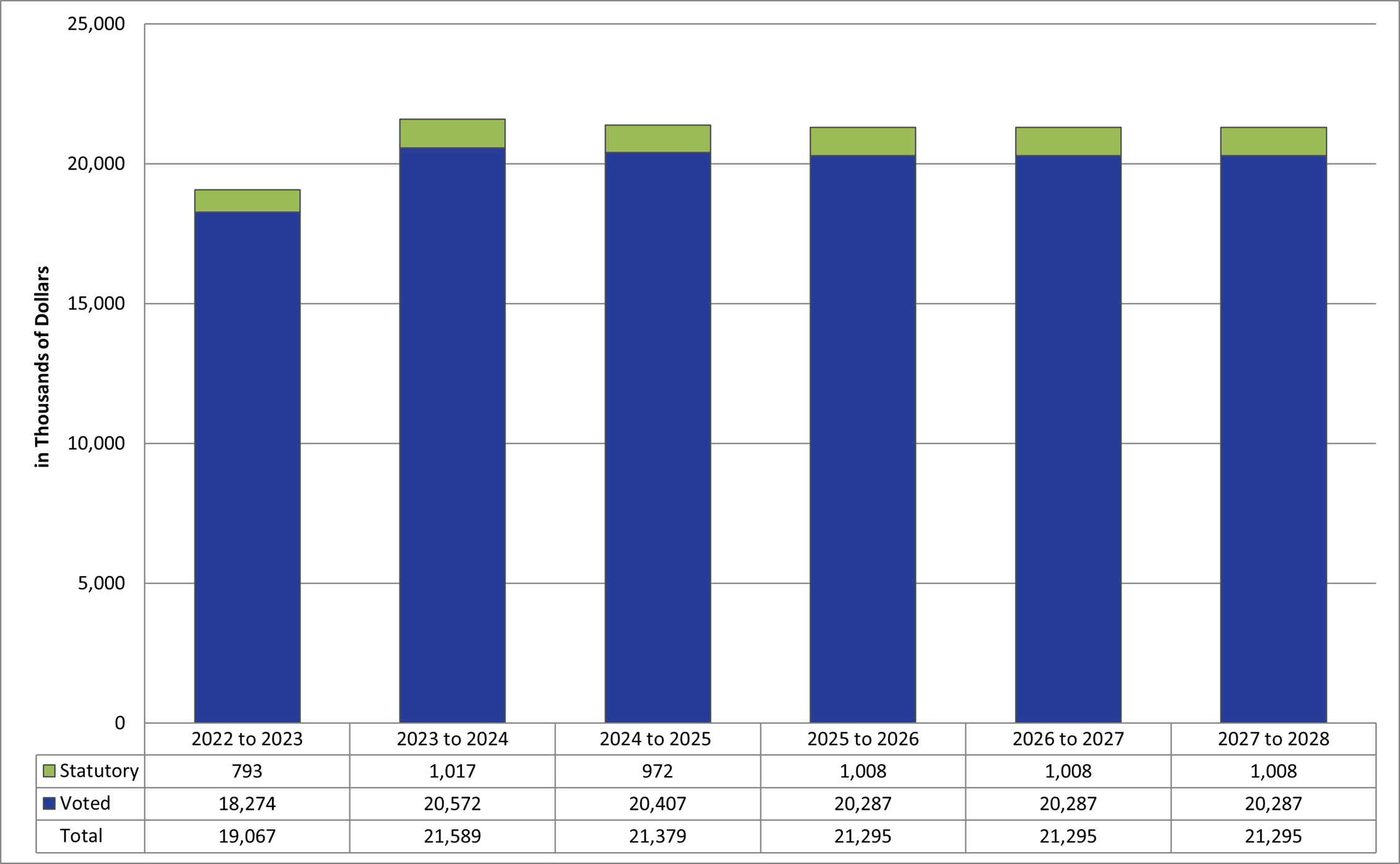
Graph 1: Approved funding (statutory and voted) over a 6-year period
Graph 1 summarizes the organization’s approved voted and statutory funding from 2022 to 2023 to 2027 to 2028.
Analysis of statutory and voted funding over a 6-year period
The organization has grown rapidly over the past 3 years and as such, we were able to make more efficient use of our resources. We have stabilized our staffing levels and built a strong foundation that helps us to deliver the assigned mandate, develop policies and procedures and bring services in-house that we previously contracted out. Operations will continue at a stable pace.
Consult the Public Accounts of Canada for further information on Accessibility Standards Canada’s departmental voted and statutory expenditures.
Financial statement highlights
Accessibility Standards Canada Financial Statements (Unaudited) for the Year Ended March 31, 2025.
Table 7: Condensed Statement of Operations (unaudited) for the year ended March 31, 2025 (dollars)
Table 7 summarizes the expenses and revenues for 2024 to 2025 which net to the cost of operations before government funding and transfers.
| Financial information | 2024 to 2025 actual results | 2024 to 2025 planned results | Difference (actual results minus planned) |
|---|---|---|---|
Total expenses | 22,118,917 | 22,088,961 | 29,956 |
Total revenues | 0 | 0 | 0 |
Net cost of operations before government funding and transfers | 22,118,917 | 22,088,961 | 29,956 |
Analysis of expenses and revenues for 2024 to 2025
The organization delivered actual results in line with the planned results from the Future-Oriented Statement of Operations.
The 2024 to 2025 planned results information is provided in Accessibility Standards Canada’s Future-Oriented Statement of Operations and Notes 2024 to 2025.
Table 8: Condensed Statement of Operations (unaudited) for 2023 to 2024 and 2024 to 2025 (dollars)
Table 8 summarizes actual expenses and revenues and shows the net cost of operations before government funding and transfers.
| Financial information | 2024 to 2025 actual results | 2023 to 2024 actual results | Difference (2024 to 2025 minus 2023 to 2024) |
|---|---|---|---|
Total expenses | 22,118,917 | 22,573,339 | (454,422) |
Total revenues | 0 | 0 | 0 |
Net cost of operations before government funding and transfers | 22,118,917 | 22,573,339 | (454,422) |
Analysis of differences in expenses and revenues between 2023 to 2024 and 2024 to 2025
This slight decrease in year over year expenditures is due to shifting priorities that caused the extension of certain contracts and the corresponding expenditures into the subsequent fiscal year. This was due to factors such as changes in organizational needs and the capacity of contracted vendors.
Table 9: Condensed Statement of Financial Position (unaudited) as at March 31, 2025 (dollars)
Table 9 provides a brief snapshot of the amounts the organization owes or must spend (liabilities) and its available resources (assets), which helps to indicate its ability to carry out programs and services.
| Financial information | Actual fiscal year (2024 to 2025) | Previous fiscal year (2023 to 2024) | Difference (2024 to 2025 minus 2023 to 2024) |
|---|---|---|---|
Total net liabilities | 3,506,892 | 3,226,399 | 280,493 |
Total net financial assets | 3,023,133 | 2,481,485 | 541,648 |
Organization net debt | 483,759 | 744,914 | (261,155) |
Total non-financial assets | 1,860,120 | 2,278,155 | (418,035) |
Organization net financial position | 1,376,361 | 1,533,241 | (156,880) |
Analysis of organization’s liabilities and assets since last fiscal year
The total net liabilities increased in the current year due to the timing of large invoices at year-end. These amounts are included in the payables at year-end. The total net financial assets increased due to the amount due from the consolidated revenue fund. The total non-financial assets decreased due to amortization expenses on tangible capital assets.
Human resources
This section presents an overview of the organization’s actual and planned human resources from 2022 to 2023 to 2027 to 2028.
Table 10: Actual human resources for core responsibility and internal services
Table 10 shows a summary in full-time equivalents of human resources for Accessibility Standards Canada’s core responsibility and for its internal services for the previous 3 fiscal years.
| Core responsibility and internal services | 2022 to 2023 actual full-time equivalents | 2023 to 2024 actual full-time equivalents | 2024 to 2025 actual full-time equivalents |
|---|---|---|---|
Accessibility Standards | 35 | 39 | 39 |
Internal services | 22 | 24 | 23 |
Total | 57 | 63 | 62 |
Analysis of human resources over the last 3 years
Up to and including 2024 to 2025, the organization completed its ramp up stage. We have recruited staff to attain the desired baseline which allowed the organization to better deliver on its mandate.
Table 11: Human resources planning summary for core responsibility and internal services
Table 11 shows the planned full-time equivalents for each of Accessibility Standards Canada’s core responsibility and for its internal services for the next 3 years. Human resources for the current fiscal year are forecasted based on year to date.
| Core responsibility and internal services | 2025 to 2026 planned full-time equivalents | 2026 to 2027 planned full-time equivalents | 2027 to 2028 planned full-time equivalents |
|---|---|---|---|
Accessibility Standards | 40 | 40 | 40 |
Internal services | 18 | 18 | 18 |
Total | 58 | 58 | 58 |
Analysis of human resources for the next 3 years
There is no anticipated growth in staff hiring over the next 3 years.
Supplementary information tables
The following supplementary information tables are available on Accessibility Standards Canada’s website:
Federal tax expenditures
The tax system can be used to achieve public policy objectives through the application of special measures such as low tax rates, exemptions, deductions, deferrals and credits. The Department of Finance Canada publishes cost estimates and projections for these measures each year in the Report on Federal Tax Expenditures. This report also provides detailed background information on tax expenditures, including descriptions, objectives, historical information and references to related federal spending programs as well as evaluations and GBA Plus of tax expenditures.
Corporate information
Organization profile
Appropriate minister: The Honourable Patty Hajdu, Minister of Jobs and Families
Institutional head: Mr. Dino Zuppa, Chief Executive Officer
Chairperson: Mr. Paul Walsh, Chairperson of the Board of Directors
Ministerial portfolio: Minister of Jobs and Families
Enabling instrument: Accessible Canada Act
Year of incorporation or commencement: 2019
Organization contact information
Mailing address:
Accessibility Standards Canada
320 St-Joseph Boulevard, Suite 246
Gatineau, QC J8Y 3Y8
Telephone: 1-833-854-7628
Video Relay Service (VRS): 1-833-854-7628
Email: info.accessibility.standards-normes.accessibilite.info@canada.gc.ca
Website: https://accessible.canada.ca
Definitions
appropriation (crédit)
Any authority of Parliament to pay money out of the Consolidated Revenue Fund.
budgetary expenditures (dépenses budgétaires)
Operating and capital expenditures; transfer payments to other levels of government, departments or individuals; and payments to Crown corporations.
core responsibility (responsabilité essentielle)
An enduring function or role of a department. The departmental results listed for a core responsibility reflect the outcomes that the department seeks to influence or achieve.
Departmental Plan (plan ministériel)
A report that outlines the anticipated activities and expected performance of an appropriated department over a 3-year period. Departmental Plans are usually tabled in Parliament in spring.
departmental priority (priorité)
A plan, project or activity that a department focuses and reports on during a specific planning period. Priorities represent the most important things to be done or those to be addressed first to help achieve the desired departmental results.
departmental result (résultat ministériel)
A high-level outcome related to the core responsibilities of a department.
departmental result indicator (indicateur de résultat ministériel)
A quantitative or qualitative measure that assesses progress toward a departmental result.
departmental results framework (cadre ministériel des résultats)
A framework that connects the department’s core responsibilities to its departmental results and departmental result indicators.
Departmental Results Report (rapport sur les résultats ministériels)
A report outlining a department’s accomplishments against the plans, priorities and expected results set out in the corresponding Departmental Plan.
Full-time equivalent (équivalent temps plein)
Measures the person years in a departmental budget. An employee’s scheduled hours per week divided by the employer’s hours for a full-time workweek calculates a full-time equivalent. For example, an employee who works 20 hours in a 40-hour standard workweek represents a 0.5 full-time equivalent.
Gender-based Analysis Plus (GBA Plus) (analyse comparative entre les sexes plus [ACS Plus])
An analytical tool that helps to understand the ways diverse individuals experience policies, programs and other initiatives. Applying GBA Plus to policies, programs and other initiatives helps to identify the different needs of the people affected, the ways to be more responsive and inclusive, and the methods to anticipate and mitigate potential barriers to accessing or benefitting from the initiative. GBA Plus goes beyond biological (sex) and socio-cultural (gender) differences to consider other factors, such as age, disability, education, ethnicity, economic status, geography (including rurality), language, race, religion, and sexual orientation.
government priorities (priorités pangouvernementales)
For the purpose of the 2024–25 Departmental Results Report, government priorities are the high-level themes outlining the government’s agenda as announced in the 2021 Speech from the Throne.
horizontal initiative (initiative horizontale)
A program, project or other initiative where two or more federal departments receive funding to work collaboratively on a shared outcome usually linked to a government priority, and where the ministers involved agree to designate it as horizontal. Specific reporting requirements apply, including that the lead department must report on combined expenditures and results.
Indigenous business (entreprise autochtone)
For the purposes of a Departmental Result Report, this includes any entity that meets the Indigenous Services Canada’s criteria of being owned and operated by Elders, band and tribal councils, registered in the Indigenous Business Directory or registered on a modern treaty beneficiary business list.
non‑budgetary expenditures (dépenses non budgétaires)
Net outlays and receipts related to loans, investments and advances, which change the composition of the financial assets of the Government of Canada.
performance (rendement)
What a department did with its resources to achieve its results, how well those results compare to what the department intended to achieve, and how well lessons learned have been identified.
performance indicator (indicateur de rendement)
A qualitative or quantitative measure that assesses progress toward a departmental-level or program-level result, or the expected outputs or outcomes of a program, policy or initiative.
plan (plan)
The articulation of strategic choices, which provides information on how a department intends to achieve its priorities and associated results. Generally, a plan will explain the logic behind the strategies chosen and tend to focus on actions that lead to the expected result.
planned spending (dépenses prévues)
For Departmental Plans and Departmental Results Reports, planned spending refers to the amounts presented in Main Estimates. Departments must determine their planned spending and be able to defend the financial numbers presented in their Departmental Plans and Departmental Results Reports.
program (programme)
An individual, group, or combination of services and activities managed together within a department and focused on a specific set of outputs, outcomes or service levels.
program inventory (répertoire des programmes)
A listing that identifies all the department’s programs and the resources that contribute to delivering on the department’s core responsibilities and achieving its results.
result (résultat)
An outcome or output related to the activities of a department, policy, program or initiative.
statutory expenditures (dépenses législatives)
Spending approved through legislation passed in Parliament, other than appropriation acts. The legislation sets out the purpose and the terms and conditions of the expenditures.
target (cible)
A quantitative or qualitative, measurable goal that a department, program or initiative plans to achieve within a specified time period.
voted expenditures (dépenses votées)
Spending approved annually through an appropriation act passed in Parliament. The vote also outlines the conditions that govern the spending.